Followers

Showing posts with label volunteering. Show all posts

Friday, May 13, 2022

A Talibé’s Hard Road Led him to Education


It has been over two and a half years since I have been in Senegal, due to the pandemic. But, my connection with the children and my friends who I travel to support has not wavered. Throughout the pandemic I have continued to mentor Sulayman, a former talibé, and support his tutoring, as he continued his high school education. He has now completed his secondary school studies and is about to write his final exams, with hopes to carry on to university. This is why I volunteer in Senegal!  Sulayman’s story, told in his own words, describes a typical talibé’s life and hopelessness. It is nearly unbearable to read, let alone to live. Most talibé stories do not end in hope and education, or lead to new beginnings, as Sulayman’s is, unfortunately. But, this one does. Please read from Sulayman’s own pen…


My name is Sulayman Ba. I was born in Gambia, West Africa. I have six siblings and I am the third son of my mother. I spent much of my childhood and youth as a modern slave, first as a slave labouring then a forced begging talibé. But education was all I ever wanted. Eventually I finally took some control over my own life and found a way to go to school.


The way I became a talibé is tragically a bit funny actually.  I  and my elder brother would always be arguing about who is going to be a school teacher and who is going to be a marabout (Islamic teacher). I was the one that would always say I want to be a marabout and my brother would say he wants to be a teacher, but I was not really being too serious. One fateful day, my late father called me and my brother and asked if we were sure of what we were claiming we wanted to become and we said of course! I was very optimistic about it at the time, I was not familiar with the system of slavery that many West African marabouts practiced. So my father sent my brother to school and he took me to one of his friends who was a marabout, to teach me the Quran. 


Although I was learning the Quran, the teacher was extremely strict. He would not even allow me to go to see my parents. Sometimes I would go to visit my parents house when I really missed them.  When this was discovered by my marabout, he would beat me up. I can still remember those beatings. I lived with him this way until he persuaded my parents to send me to another village in Gambia. When I arrived in this village I was given over to another man, left alone with him. I remember on the second day my shoes disappeared. At this time I started crying, realizing my life was to be real hardship. I was so young at that time that I can't even remember what my age was. 


This village was composed of many "talibés". In this village we talibés were the labourers. We were forced to work on huge farmlands. We grew groundnuts and maize. We consumed half and the other half was taken for sale. We also took care of gardens for the son of our marabout in that village. We mainly cultivated bananas and onions. Our marabout had more than 400 talibés and there were only a few rooms for us to sleep in. It was like a prison inside our rooms, there was not even space to step or walk. There was a long time that I only had the clothes I was wearing and no shoes on my feet while I had to do this hard work every day. The life in the village was like a hell for me, particularly in my first year before I got somewhat used to the situation. We did not have electricity so we would go to the forest everyday to fetch firewood. We would burn that wood for our light at night and when we had to wake up 4:00 in the morning to learn the Quran until 7:00 am. Then we would be sent to work all day. 


There I was until my father passed away. I wanted to go home and my mum visited me there in the village only twice and I would cry whenever she was leaving. But she always told me “I have no choice Sulayman, your Dad wanted you to learn the Quran and become a marabout and he always reminded me of this” my mum said. So there I remained until I was finished the Quran. But then my marabout in that village decided to take me to Senegal to continue studying. This was how my journey to Saint Louis came about. 


I was taken to Saint Louis, Senegal with one of my daara- mates, who  was also a Gambian. When we arrived in the city around 8pm we were supposed to be taken to the "ville". But we were not allowed to stay in the place we were sent. Instead we were sent to a different marabout. We eventually arrived at this other daara later that night and it was full also. But the marabout let us stay there with some of his talibés despite it  being overcrowded. I remember it was so dramatic that night! 


My first morning in Saint Louis, I woke up and was sitting waiting for breakfast. We were extremely famished after our long journey and the the chaos of the previous day without food.  One guy came and told us boys “I know you boys are new comers, but here in this daara you have to go out beg for food or look for job in order to survive.” We of course had no money, so we went to the market with some of the other talibés to try to get jobs carrying people's stuff. We were paid very small amounts actually, not enough to even buy food. That was how we were living for several more years. 


I was forced to do many tedious jobs in Saint Louis just for survival to take care of myself, and also to give my marabout money. No one else cared about taking care of me even though I was a child. I can remember my first job apart from going to that market was sweeping. There was a very wicked woman named Aja that I was working for, she was very mean to me. I did not understand the money, and I would wake up every morning and clean everywhere in the house up and down everyday, with no days off. For this I was paid 2000cfa a week (about US$3.25). But this woman often would not even pay me that small amount so I left there and I returned to the market to earn what I could.  


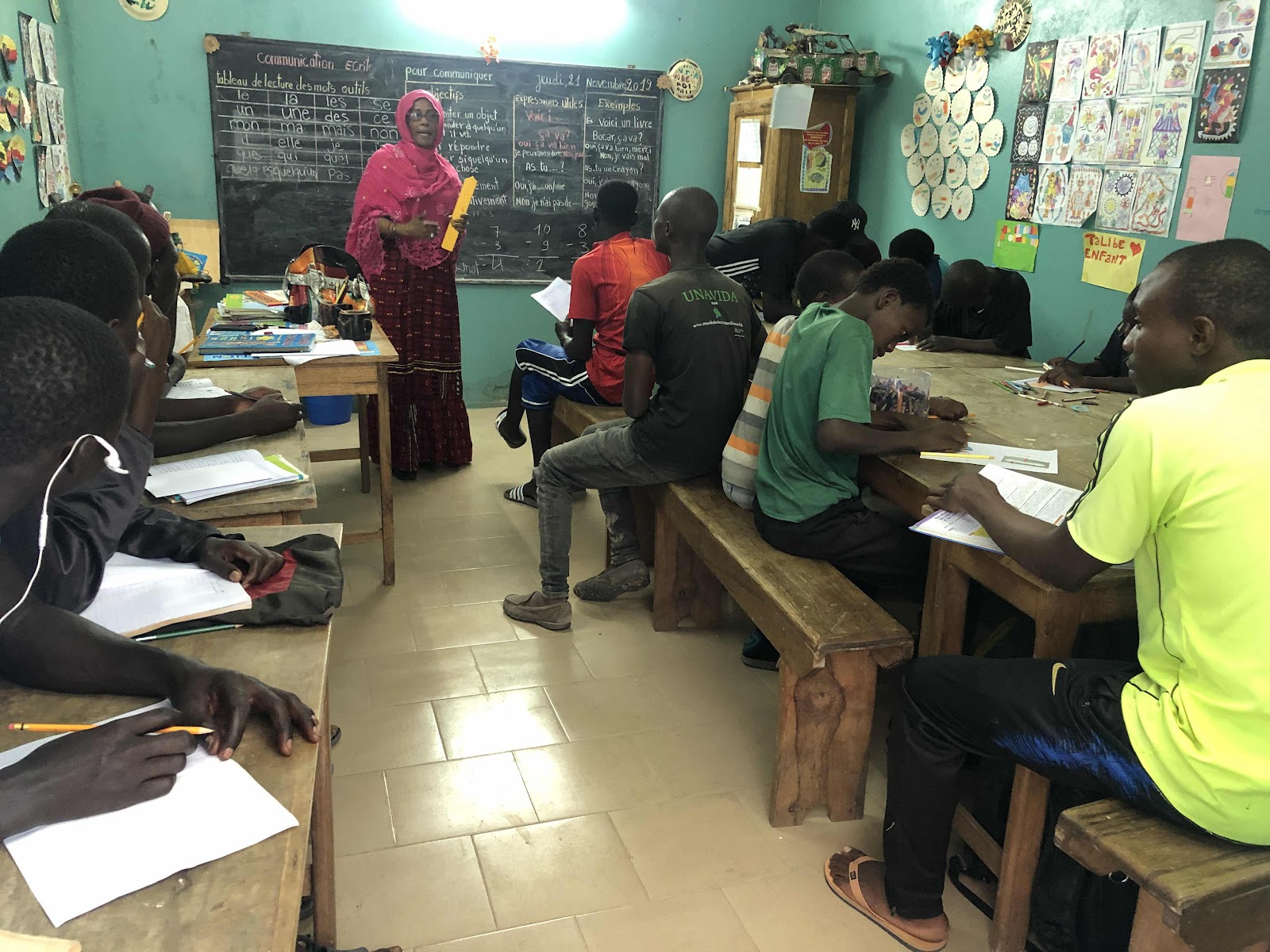
In 2015 I learned about some centres helping talibés like me. I started going to the centres and found Maison de la Gare. Whenever we were returning from working in the market we would pass by Maison de la Gare to take a shower and sometimes watch films and play. We would also come back in the afternoon and eat free food they gave us. I joined karate classes too. I started falling love with it. Maison de la Gare was a break from my very hard life. I spent as much time as I could at Maison de la Gare. I started getting used to the people at Maison de la Gare, and trusting them, especially the teacher, Abdou Soumaré. He always would advise me go to the classes and learn French or English, that it may help a lot in my life. 

Sulayman and Abdou


At that time I could not understand anything in either English or French so I found it pointless to sit in the class room. I could not tolerate my life in the daara any longer, so I was eager to escape to Europe, through Libya or Morocco. Four of my friends had gone on that journey, and I wanted to do it too. That was the year I left the daara and went to Mauritania to try to find a job and then make my way to Europe. But Mauritania was even a worse nightmare for me. Even more terrible than living in the daara. I returned to Saint Louis and finally took Abdou Soumaré’s advice. He had always been telling me I should try to go to classes and at least learn to understand one official language that could help me in life. So I started learning English with some of the volunteers at the centre. I remained at the centre until I started speaking a bit of English. I even joined the karate dojo and earned my yellow belt.
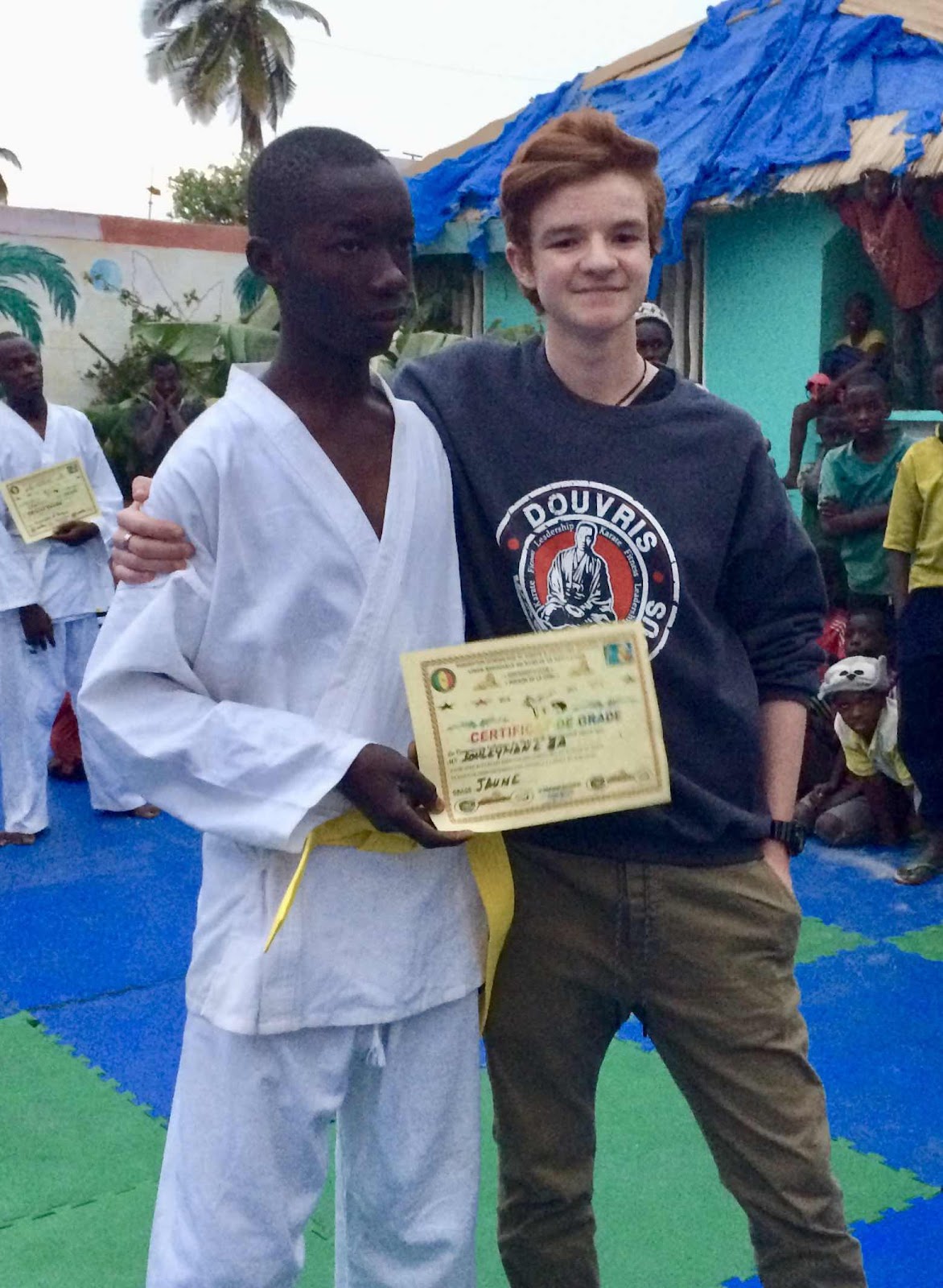
Robbie granting Sulayman his yellow belt


I returned to Gambia in late 2018, but I found my mum had a heart attack and my elder brother was not working. My uncle was the one taking care of this whole family and I had the feeling that I needed to make a change. I was wondering how I could make my way through my entire life with only having learned the Quran. I refused to treat other children the way I had been treated, as slaves, so being a marabout was not for me. I felt quite useless in my family. I went back to Saint Louis, and my main objective was to try to support myself, enrol myself to school, get my certificate, and then start working to become the bread winner of my family. I refused to return to the hell of the daara so I lived sometimes on the streets, sometimes at friends’ rooms, and sometimes at Maison de la Gare’s dortoir (emergency shelter). I continued to go to the Maison de la Gare classes.


I explained my situation and my desire to go to a real school to some of my friends. One friend who motivated me the most to find a way to go to school was my friend Tijan, also from Gambia. Tijan and I almost have similar stories. He was the one who would tell me “Sulayman stop thinking about this back way of going to Europe. You can make it in your own country.” He had returned to Gambia to go to school a few years before and he was going to graduate from high school! He was at that time in Senegal only briefly to visit Maison de la Gare. Tijan convinced and inspired me to return again to Gambia, this time to go to school. Abdou Soumaré and Issa Kouyaté, the president of Maison de la Gare gave us both some advice and wished us well. Tijan and I returned to Gambia together. 
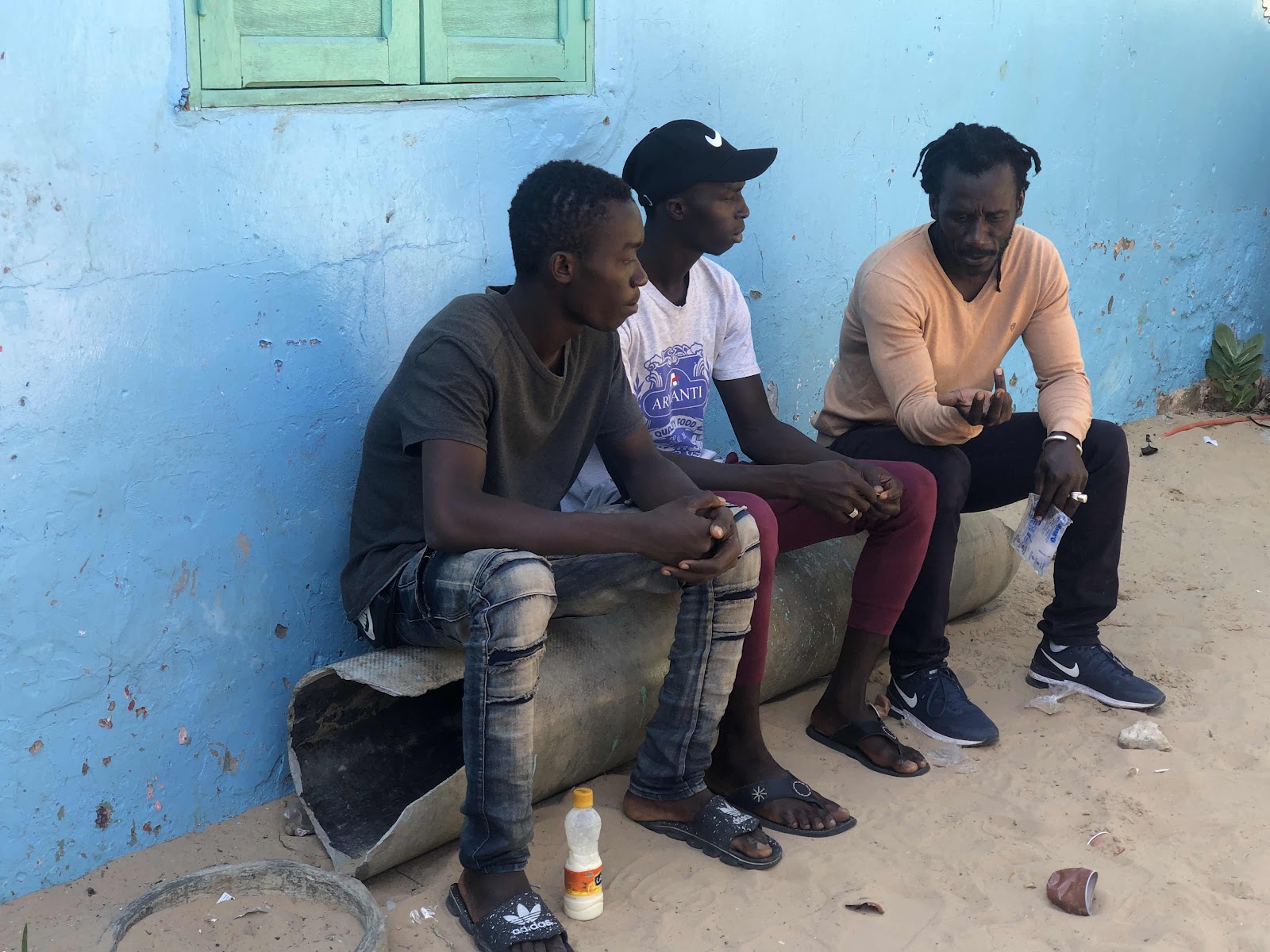


Today I believe that everything in life is possible. You just have to believe in yourself and give it a try. If I didn't believe in myself so strongly at this point, and already been through so much hardship, I would have dropped out of school the very first week that I enrolled. I will never forget this in my life: my very first test in school I earned zero out of one hundred. The teacher called me in front of the class room and embarrassed me in front of everybody. But, I didn't give up or think “well, I am stupid  and I can't do this” instead I was like “ahhh, this is my first time in school, so it's not the end of the world. I’ll do better next time after I learn something.”  I thank God now, Alhamdulillah!! that I stuck with it. I have learned much and improved a lot, advancing through all my high school grades. I am not bothered that I am of such an older age compared to my classmates and I am now at the last stage of high schooling. I have completed my high school studies with the help of tutors to help me get caught up for all the education I missed as a child. I have qualified to write the WASSCE, the West African Senior School Certificate examination, which I will be attempting this spring.


My hope for the future is to get good results in my upcoming exams. My high school diploma and good exam results will open the door for me to further my education. I hope my hard work and perseverance will give me the chance to go to university, to continue my education. I want to do it for myself and for my family. I believe education can brighten my life, it is the way.


Saturday, March 23, 2019

Lala and the Beautiful Game


Lala sits under the shade of the bougainvilleas, talking to a little talibé. Lala is listening to him, giving him her full attention. She speaks a few encouraging words. He nods, she pats him on the shoulder and he runs off. 

Maison de la Gare is lucky to have one dedicated, long term volunteer, Lala Sene. Lala played soccer for Senegal's Women's National Team in 2006, 2009, and 2012. Soccer was her life, until 2017 when she received a career ending injury of a double fracture to her right foot.  Wanting to use her skills to help the forced begging talibé street children of her city, Saint Louis, she began to volunteer at Maison de la Gare, coaching the soccer-crazy talibés and organizing a weekly tournament at the centre. 


As Lala's injury healed and the talibé boys of Maison de la Gare captured her heart, she increased the frequency of her volunteering until she could be found at the centre everyday, helping to prepare the daily food or lend a hand wherever it is needed. The Thursday soccer tournaments continue, but frequent  informal pick-up games now also offer regular opportunities for the boys to receive coaching tips and the extra special attention that is so lacking in their lives.


Lala was born in Saint Louis, into a family of sixteen children. She began to play soccer at age six, with the boys in her neighbourhood.  Her father knew of her love of the beautiful game  and could see that she was always the best player on her teams.  He encouraged her to feed her passion and pursue her dream of playing professional soccer. When her father was on his death bed, he asked Lala's coach to watch over her and continue to encourage her, a wish which her coach has continued to honour. 

Lala's parents are both gone now. She lives in her family home with five of her sisters and three of her brothers. They support each other, and they encourage her in her devotion to the talibés, recognizing the importance of this work for her.


Lala is now completely devoted to the talibés. Her greatest worry is that if she falls sick, or even needs to take a few days away from Maison de a Gare, that the children will miss her. She says "If God is good, I will be able to remain at Maison de la Gare and help these children who trust and need me." She adds that the talibés are like her little brothers or her own children. It hurts her heart to be away from them. It touches her deeply when the talibés call her name out to her on the streets of Saint Louis.

It is Lala's greatest wish for the future to be able to continue to commit herself to the talibés boys of Maison de la Gare.

"I feed myself off of my love for the talibés and their love for me. I am one with them."
- Lala Sene


Sunday, March 19, 2017

Tournament Day - the Only Thing Better than Grading Day


Last weekend five dojo talibes travelled to the region of Kaolack with Sensei Ignety Ba for their first National karate tournament. This was made possible by a donation from Douvris Martial Arts Barrhaven and Brigitte Pellerin's pledge to the Maison de la Gare karate program from sales of her book, Not Just for Kicks, Dublin 2016. The eager competitors and their Sensei left in the early hours of the morning,  meeting to catch the bus at 4am, after we trained together at the dojo the night before. The WKF tournament was Saturday and Sunday morning. Not yet ready to perform kata at a National level, the boys were there to fight. And, for kumite. 

Bouaro and Omar both won their first fights. But, neither moved on from the second, and therefore they did not place this time. The kumite competition was strong as well, and no one went home with medals.

 Omar in the red belt at Kaolack National Tournament

 The drive home across much of Senegal Sunday afternoon lasted through the night. The competitors had not slept for several days and were exhausted Monday when I saw them at the Maison de la Gare centre. They also seemed somewhat despondent about not bringing home any hardware. But I could not have been prouder of each of them. Sensei Ignety Ba also was proud, and reminded them of the importance of competition.  He pointed out they were lucky to be able to attend a National competition, as most in their dojo, even the regular members, had never been, due to the prohibitive cost. Ignety told them defeat makes you train harder, and to focus on what needs improving, and it helps you to be humble as all the best competitors must be. He  reminded the young men it can take years of training and competing to begin to win consistently, and that no competition is ever wasted.  I have heard these same words from our own Master John Douvris, coach of the Douvris Tournament Team and the WKC Canadian Karate Team. Wisdom.

Robbie and I had hoped to run a tournament at the centre for the young karate kids who attend day classes. We were delighted to discover that Issa Kouyate, President of Maison de la Gare had forseen such a day and had purchased a stock of karate medals as prizes. Robbie had also brought many Douvris tee-shirts from home to use as prizes and others had been donated by Douvris members. Inspired by the dojo tournament team, the first in-house Maison de la Gare tournament would be on!
 
Admirers gather around the prize table

We kept the mats that were rented for the Grading Ceremony until Friday, the day of the tournament (and of our departure). Friday morning dawned. The mats were layed out, a prize table arranged, and as the karate kids began to arrive they put on their gi's and mulled around, not knowing what to expect, but sensing that something was about to happen that would put them in the spotlight. Djembe drums were pulled out, and music began. Crowds gathered around the prize table, admiring the medals, the tee-shirts, and the juice drinks, envious of the karate kids who would be competing for these rewards.

the kata scoresheet
 
Sensei Gora Seck, a WKF referee who generously volunteered to help us, arranged a score sheet for kata and another for kihon. There were 18 competitors, 18 medals, with the winning four of each group receiving a yellow ribbon for their medals, a Douvris shirt, and a juice. The competitors who did not place would receive medals with a red ribbon and juice. The grand champion, kata was presented with a special medal and Robbie's 2014 WKC World Championship sweater from Dublin (where he had competed with the Canadian Karate Team).

The two teams were lined up, salutes were exchanged, and the competition was on. Sensei Gora Seck was assisted by Bouaro, calling each pair of competitors up in turn, starting with kata. Each boy was given either a red or a blue belt to wear during his performance, just as in WKF sanctioned tournaments. Some of the belts were so big and the boys so small that they dragged on the ground. But, the boys were clearly proud to be wearing them. After bowing to the judge and to each other, each performed his kata. There was a wide variety of skill level, but each competitor seemed equally nervous, excited and proud to be on the mat, laying down his best performance, wearing a red or blue belt. They lined up again and Sensei indicated his decision with the referrees flags, red or blue.


With each win, a competitor was eliminated. Eventually a final set of four remained for kata and for kihon, the finalists. A few performances stood out from the rest, earning  prolonged applause from the appreciative audience. 

 Amadou Diallo's performing his winning kihon's

For kihon the clear winner was Amadou Diallo, an eight year old (he thinks) who has been coming to karate classes for over a year. 

It is fitting that this boy's participation in karate has been sponsoured by Martina Couture and her dojo Douvris MA Barrhaven, because she contributed to making this tournamnet possible. The kata winner was Samba Diouf. Pride beamed from his face as Robbie presented him with his well deserved medal and his world championship sweater. 

 Robbie with Samba, kata champion

After the medals had been presented the kids again lined up for a final bow and a further round of extended applause. We heard many little talibes who had gathered to watch telling each other and anyone who would listen that they too were going to join karate. Our objective had been to reward the kids who have been working so hard against such terrible odds, coming to classes as diligently as possible, developing real skill and building a true passon. And, to motivate and inspire them to continue to do so. Mission accomplished, and more! And, I have no doubt we will need to bring even more karate gi's on our next visit to Maison de la Gare.

Robbie and Sensei Gora Seck congratulate the competitors 

Saturday, March 18, 2017

Kalidou - A Talibe Success Story


Kalidou's story with Maison de la Gare began in 2008. He was 6 or 7 years old at the time, he is not sure. 

From Kolda, in the Cassamance region of Senegal, Kalidou and his two older brothers were sent together to his marabout to be talibes in Saint Louis, begging for their own living as well as a quota of money for the marabout, but also to learn the Quran. His younger sister remainded in the village with his parents. His family are farmers, and Kalidou remembers that their life was very hard. Last year Kalidou returned to his village for the first time since leaving in 2008.  Kalidou's older brothers returned to Kolda in 2011, having completed their memorization of the Quran. Kalidou had finally completed his memorization of the Quran, and it is tradition to return to one's village at this time. He says he did not recognize anyone but his mother, and they also did not recognize him. When Kalidou saw how much his village and the people he knew as a child had changed, and how difficult life there remained, he realized his home was now in Saint Louis, and his family is Maison de la Gare. Nevertheless, he will continue to send money to his parents when he can. It is Kalidou's hope to someday be able to bring his mother and father to Saint Louis to live with him, as he does not know how they will survive as his father ages and can no longer live the difficult life of a farmer. He also hopes to someday marry a girl from Cassamence (of his parent's choosing) and to bring her back to live in Saint Louis.

When Kalidou first arrived in Saint Louis he was lucky to soon meet Issa Kouyate and Maison de la Gare. He attended French classes at Maison de la Gare's previous location, the old, run down train depot near the Pont Faidherbe. 
 
Kalidou at the old train station with MDG

My sister Lisa and a fellow volunteer, Zoe encountered Kalidou at Maison de la Gare in 2008 when they were teaching French. Each time I return to Saint Louis, Kalidou askes me if I have news of Zoe. He remembers her fondly as his first teacher, and he thinks of her and misses her to this day. Last year I suggested that Kalidou send her a video message. He prepared his remarks for days, thinking carefully of what he wanted to tell her. Kalidou is very shy, but sending Zoe a greeting was clearly very important to him. 
Watch Kalidou greet Zoe here.

Kalidou  remains shy and humble to this day. But, his confidence is growing. Kalidou is a member of Maison de la Gare association. At the annual general meeting yesterday, when called upon to comment, Kalidou adressed the large group with eloquence.
 
Kalidou speaking at the annual general meeting of MDG

Kalidou learned French and quite good English at the classes offered by Maison de la Gare. Several years ago Maison de la Gare arranged for Kalidou to begin to learn the craft of couture, and later to apprentice as a taylor. He has been working for the past year with the tailor Baka, at the shop Baka Fashion. Baka tells me Kalidou should be ready to complete his apprenticeship in about one year, advancing to become a taylor in his own right. An apprenticeship of about 3 or 4 years is typical. However, Kalidou was already oriented somewhat to his craft when he began his apprenticeship. Indeed, Baka says Kalidou is ready to start to transition and could earn money by having a sewing machine of his own at home. Kalidou spends about three hours each day apprenticing.
 
Kalidou with the taylor, Baka

After his work at Baka Fashion, Kalidou visits his daara to study the Quran with his Marabout, Seringe Mansour. Although Kalidou has memorized the Quran already, he still feels he has much to learn about being a good Muslim. Personally, I think he is already one of the best I have met. 
 
Kalidou at his sewing machine at Baka Fashion

When Kalidou is finished at his Daara he comes to Maison de la Gare, where is is now working as a talibe in transition in the role of assistant teacher, instructing English. He also spends the weekends with Maison de la Gare, helping out however he can. He is an example to other talibes. Kalidou demonstrates that there is hope that talibes can realistically aspire to better lives.

Kalidou with Issa, many years ago

When asked what Maison de la Gare has meant to him, Kalidou  says he was really helped in learning English and French. Maison de la Gare has allowed him to remain in Saint Louis and to train for a trade. To Maison de la Gare, Kalidou says: "Thanks for my life. It is good."

 
Kalidou teaching an English class at MDG

Friday, March 17, 2017

Grading Day!

 
The yellow belt candidates

They waited  together nervously outside the dojo, in the night, for their turns to enter, salute their Sensei, and begin the test to advance to yellow belts. One by one they were called in. The waiting students could not see what transpired inside, adding to thier growing anxiety. First the salute.  Then, Sensei Ignety Ba began to call out various blocks and strikes in Japonese. The kids were expected to respond immediately, and acurately. 

Thirteen Maison de la Gare dojo talibes had been invited to grade for yellow, along with five non-MDG students of Sor-karate Club.. Before the test began, Sensei Ignety Ba explained to the candidates that belts are earned, not gifted. Months of dedication is required. Forms must be not only memorized, but performed correctly. Japonese terms for each block  and strike must be known intimately enough to respond accurately and without hesitation when called upon. Kumites must be precise and forceful. Salutes and kiayes must never be missed at the right moments.

 
The candidates grading at the dojo

As each candidate entered in turn Robbie and I watched in silence, seated beside Sensei Ignety Ba as they saluted their Sensei and awaited instructions. Many were sweating with anxiety. I was nearly shaking myself, my own nerves getting the better of me as I imagined myself in their shoes. I wanted so much for each and every one to pass. But, I began to sense from Ignety a premonition in his subtle demonstrations of disapproval, impatience, or pride in students who's gradings were progressing well or not as well. A few were asked to leave before having performed Kumite, a bad sign.

Arouna and Ismaila performing Kumite during grading 

It took several hours to grade the 18 candidates, then Sensei gathered the candidates again. He again reminded them that belts must be earned by demonstrated hard work, respect and skill, then called upon the boys one by one. My heart sank as the first candidate, my beloved Arouna Kande was not passed. Then the second, Ismaila also not passed. But then, the first pass, for Amadou Sadio Diallo! Dijibi Balde, pass! Oumar Sane, pass! Mamadou Balde, pass! Souleymane Ba, pass! Boybacar Ndiaye, pass! Issa Ba, pass! But then, Moussa Ba, not passed. Then Yaya not only passed, but was praised as excellent, the star of the dojo! Amadou Sadio Camara and Abdoulaye Diallo sadly also did not pass. None of the five non MDG candidates passed either. In the end, eight earned their yellow belts, all from Maison de la Gare. Sensei informed the MDG candidates who had not passed that they were close, so they would be given the opportunity to test again in only another month, much shorter than the usual wait.

As we later walked away together from the dojo the atmosphere was a mixture of quiet disappointment and elated celebration. My own feelings were just as mixed.

A day after the celebration and heartbreak of the yellow belt grading a presentation ceremony was held for all the dojo talibe yellow belt candidates at Maison de la Gare. I rented mats, which the boys transported by taxi and set up at Maison de la Gare. Tables were carried out from classrooms and set up as a head table. All the candidates, passed or otherwise put on their gi's and lined up, respectfully awaiting their Sensei. 

 
Sensei Ignety Ba with the new yellow belts, before the presentation

First Sensei Ignety Ba invited Noel Coly of Maison de la Gare to address the crowd. Then he himself spoke of the importance of service, referencing Douvris MA, Robbie, my Dad and I and Maison de la Gare. He spoke of perseverance, referencing the hard work of the talibes in pursuing their passion for karate.  I could only marvel at the echo of his words. The Douvris MA word of the monh this month is Service. Last month it was: Perserverance. Then Sensei Ignety Ba, assisted by Sensei Seck, called upon members of Maison de la Gare, Dad, Robbie and myself to present certificates of grading to each candidate in turn. Even those who did not pass received two stripes on their white belts and certificates, as Sensei was confident they would soon earn them. As the successful candidates were called up to receive their belts, the abundant joy and pride could not be contained. 

 
Boubacar Ndiaye being congratulated by Ignety Ba

 
Issa Kouyate presenting Robbie a certificate of honour on behalf 
of Master John Douvris

Then a surprise, I was called upon to receive a certificate of honour on behalf of Sensei Martina Couture, of Douvris MA Barrhaven. It was granted for her precious contribution to sport and the social good in Saint Louis and to the advancement of Maison de la Gare. Robbie was called up to receive a similar certificate of honour on behalf of Master John Douvris of Douvris Martial Arts. Then Dad received a certificate, then Robbie, and then so did I, accompanied by lasting applause. It was an overwhelmingly proud, emotional moment for all of us.

 
Sonia presenting belt and grading certificate to Issa Ba

As we all proudly gathered together for a photo opportunity, I was reminded again that when practicing karate, these boys are no longer talibes. They are martial artists.

Sunday, March 12, 2017

Making the Most of Opportunity

 
Maison de la Gare morning karate class

Our first day in Saint Louis was full, despite Robbie and I sleeping in. Dad, of course was up early at work, never a moment to lose. We arrived at the centre to a karate class of about 25 kids in progress. The skill level of the karate kids was really impressive. Four boys in particular made a real impression on us with their apparent dedication and skill.  Watch two of them here:


Robbie pointed out that these children seem to view karate as a privilege, and many of them give it everything they have, striving to make it their own. They are respectful of their Sensei, waiting in the hot sun for the next instruction and then doing their best to perform correctly. They don't have parents or any reasonable structure in their lives. They are not fed or given any care when they are sick other than from Maison de la Gare, or what they can beg. They are forced to deliver quotas of money to their marabouts each day, proceeds of begging.  Maison de la Gare staff and volunteers provide the only positive roll modelling in their lives. There are so few staff, and thousands of talibe kids. But here they are, working hard, focused, sweating, probably hungry. Karate is exactly what these kids needed.
 
We met with the kids who would be travelling to Kaolack later that night for their first National Tournament to provide new gi's that they would wear in competition, donated by Douvris Martial Arts Barrhaven.Two of the talented kids in the morning class also indicated they wanted to join the dojo. Next week we'll gauge their comittment, and if they seem ready, two of the new gi's may be theirs. 

 
Some newly registered karate students at the dojo during my previous visit

Robbie and I joined the dojo talibes to train at Sor-karate Friday night. We left the centre just before the evening light meal was served. Unfortunately in order to arrive at the dojo in time ( it is about a 20 minute walk) the kids often forgo their meal from Maison de la Gare. Robbie and I both participated in the class with the advanced belts, so we were not able to take photos this time. We both felt privledged to train with this group, who give such an effort to their practice.  We learned new kumite routines and worked hard. Our conditionning thanks to Dourvis Martial Arts paid off and although the class was a challenge and we also worked hard, we were not exhausted. In fact, we were surprised when the sensei and talibes asked us if we were tired. After an intense warm up the class tends to get 1 or 2 minute pauses between sets of about 10 minutes for the boys to rest. Sweat was pouring off them. and they were tired. But of course they continued to give the practice all their focus and strength until the very end. It dawned on me that these kids were working through more calories than they had likely consumed that day! They had not eaten an evening meal. And they likely had not had much more than some bread or a bit of rice earlier either. And there would be nothing waiting for them later at the homes they do not have. I was hit hard by the realization of the things we take for granted.  Robbie and I also had missed dinner, but given our regular diet we could not have begun to imagine what the talibe boys were experiencing. After class we distributed all the granola bars we had brought for the trip. Later when Robbie and I met Dad for a late meal we found it difficult to eat much, thinking of our talibe karate friends.

Nutrition is important to all athletes. To malnourished kids consuming so many calories pursuing a passion that gives their lives meeaning, food should not be a rare luxury. Robbie and I determined to find a way to help these kids eat before karate practice on a regular basis. we'll keep you posted as we try to figure this out.

At the dojo I discussed the impending belt testing with Sensei Ingety Ba. He had been planning to test the round of white belts we signed up a year ago and some of the more exeptional white belts we signed up on my most recent visit 5 months ago (all thanks to sponsourships from Canada) in about a week. Thirteen Maison de la Gare white belts will be testing! He generously moved up the belt testing to Tuesday night, so we could have a presentation ceremony at Maison de la Gare Wednesday for the successful candidates while Robbie and I are still here. Douvris Martial Arts Barhaven and some Canadian karate students generously donated belts for us to bring to Senegal. If these kids are successful, we will use every one of the donated yellow belts! Upon being informed of testing, the white belts seemed nervous but excited. They worked a long time to become ready, and many still feel anxious.

Robbie offered to work with the kids who will be testing each day until Tuesday, helping them fine tune their katas and kunites and to prepare as well as possible. Saturday morning at the centre Robbie worked with three kids who will be testing, Souleymane, Issa Ba and Moussa Ba. Also, Elhaje practiced despite not being on the test list this time. He wants to take the opportunity to improve so he can make the list next time. The sun was hot, and the gi's were hanging up to dry after being washed, but the practice session was a success.


Today, Sunday, we met the kids at the centre again. Yaya also joined the group, and the kids worked hard with Robbie for two hours on getting the shodan, heidan and yodan versions of taykokyu shodan down and improving their form and timing.  Robbie and I have attended a Sor-karate belt testing before. Just only about two thirds of the candidates passed. Robbie is confident these 4 have what it takes to pass to yellow, even to Sensei Ignety's exacting standards.


With the dojo talibes who successfully test being rewarded with a belt ceremony, the younger karate kids who practice at the centre will surely be inspired. And, and with the four Sor-karate talibe kids competing at their first ever national tournament in Kaolack this weekend, Issa Kouyate, president and founder of Maison de la Gare has been saving some medals and suggested a tournament for the little ones. Let's Go! says Robbie. So beginning tomorrow, Robbie will work with the karate kids each day until the end of the week to prepare them for their own first ever tournament. Can't wait!

 
A flyer to collect gi's and sponsorships, pictured is Robbie with the first group 
of dojo talibes, now yellow, orange and green belts

Thursday, March 9, 2017

The Road, a Senegalese Shakedown

Climbing the steps into the Dakar airport from the tarmack involved less of a rush than usual. Usually there is quite a bit of jostling for position as the lines to clear customs can be long and slow. But, many of the passengers on our flight remained on board, to continue to Conakry. So, the line was less crowded. And, a previous requirement for completed customs forms and Visas had been abolished. So, the lines moved quicker. service was polite and efficient, leaving us on time and feeling good.
 
we stopped along our route at this roadside coffee shop for a caffiene break

When visas had first been introduced as a requirement for travelling Canadians to Senegal, several years ago, we had the pleasure of being directed down long passages to a tented outdoor extention to the airport. We then enjoyed a very long wait while wonderng what we were waiting for. A sum of Euros was exchanged to pay for the Visas, then we were directed to booths for questionning. My questionning went fairly quickly, interupted only once or twice for my customs officer to take a personal phone call. however, my Dad's questionning was a bit different. Many breaks for personal phone calls were accompanied by regular breaks to get up and chat with colleagues, certainly not about anything relating to Dad's questionning. Was there sonething wrong with his computer? Did Dad appear as a suspicious character? The officer would answer none of our questions. After an extended period of time we guessed the customs officer was waiting for us to offer a bribe, So, Dad got up, went back to the sitting area and waited for a dfferent, less corrupt officer to become available. Eventually one did, and we were out in short order and on our way without any further money changing hands. If it were not for our committment to Maison de la Gare, this experience would have killed my desire to ever return to Senegal. I expect many travellers felt the same way and travel  diminished. Now there is happily no longer a visa requirement.

On a visit a year ago, while transporting an unusually large shipment of medications supplied for our humanitarian mission by Health Partners International, our bags were held at customs. Our manifest and signed and stamped authorization and letter  from the Senegalese embassy in Canada was ignored, despite having satisfied all customs requirements on many previous visits. We did not offer to solve the situation with a bribe. We tried logic, shame, tears, all to no avail. It later took Maison de la Gare many weeks and many trips back and forth to the airport and many different government departments, receiving stamped approval after stamped approval to eventually recuperate the medications for the intended purpose of providing free care to Senegalese children who would otherwise get none. Thanks to our experince with customs on this occasion, we will not likely be bringing medications again for Maison de la Gare any time soon.
  
bags full of medications for Maison de la Gare

On the way home a few trips ago, on the way from Saint Louis to Dakar, we were pulled over by a random police check-point. Unfortunately for the officer, all our driver's papers were in good order. So, he searched the car. Eventually the officer was rewarded with the discovery that our car was missing a triangle for use in roadside emergencies. This search required moving our baggage and potentially jeopardized us catching our flght.  If you could see the motley collection of ancient and overloaded vehicles on this road, many seemingly just held together with string, you would realize the ridiculousness of our situation.  This incident took so long, again, because our driver refused to offer a bribe. He ranted about how such corruption was killing  his country, and he refused to be part of it, regardless of the business consequences. Eventually, the owner of the transport company we had hired arrived on the scene to get involved, and we were again on our way.

Today on the way from Dakar to Saint Louis we were stopped at another random police checkpoint. Again, all our drivers papers were in order. But, the officer complained the baggage was piled too high in the trunk, obstructing a clear view. Again, if you could see the overloaded vehicles travelling this road...The officer had returned the registration, but held on to our driver's license. Our driver returned to the car for his wallet, and I saw the equivalent of about $2 change hands. We were once again on our way, but with a bad feeling about the country nudging its way in.

 
our driver and the police seen through the "obstructed" view

WHAT are the people making decisions in this country thinking?!?  How does this type of skakedown help anyone? Why does this type of behaviour not get SHUT DOWN? The corrupted are among those with jobs and salaries. I expect they are relativly few, but many stand by and let it happen. The victims either cannot  afford to be victimized, or they can, but the presence of corruption nudges them to take their business or tourist dollars elsewhere.  There are many local heroes, good people who know things don't have to  be this way. Our driver of last year taking a stand. Maison de la Gare willing to jump through ridiculous and unreasonable lengthy hoops to avoid  playing the game. Will the honest, resillient people of this place be enough to counter the self harm done by corrupt officials, and those many others who turn a blind eye, accepting it as just the way things are done, sighing as they say: "c'est l'Afrique..." Insha'Allah.
 
a typical sight on the Dakar- Saint Louis route

Wednesday, October 5, 2016

Goodbye for Now, but Not for Long, Insha'Allah


It is always so difficult to leave Maison de la Gare. Yes, progress has been made, supplies were delivered, issues were resolved, children have been registered in school, 8 more kids are registered at the dojo, karate seems locked-down and a future karate volunteer trip is fleshed-out, the medical report was completed, articles were written. Dad has slogged through his own long list of objectives as well - sleep is so over-rated, after all. But, despite the satisfaction of accomplishment, It tears at my heart to walk down the alley away from the centre. I can never be sure if I will see these boys again. 


The lives the talibes lead are so unpredictable. They have so little control over their own destinies and are at the mercy of the whims of their marabouts. Kids who have been attending classes at Maison de la Gare, learning to read and write, who feel secure in knowing the staff truly care about and watch over them, could disappear without warning. Marabouts can move an entire daara of kids to a remote location to work their fields as a convenient source of slave labour. Or, children could be arbitrarily barred from Maison de la Gare if a favour for a marabout's personal gain was asked of the center but refused. Or, a child suffering intolerable abuse at his daara could silently vanish and become a runaway, alone and vulnerable on the streets. On my last visit I was horrified to learn a group of 12 children from one daara who had passionately participated in the karate program were barred from returning to the centre by their marabout. The marabout had attacked one boy to punish him for some "transgression"  (an unfortunately common occurrence) and the boy had defended himself with the skill of a martial artist. Only by squashing the hope and the budding karate talent of these boys did the marabout feel able to keep them under his boot.

A young talibe in karate class 

On this visit I was distressed to discover one of my dear teenage talibe friends is seriously considering leaving Senegal to try to make his way across the desert to Libya, and then onto a migrant boat, and then to Europe in search of a better future. He has heard it is possible to get an education in Europe. He has identity papers back in The Gambia, so he could attend high school there. But, he has an intolerable family situation at home to which he cannot bear to return. We had many discussions about the terrors and dangers and extortion of illegal migration to Europe. We also talked long and hard about the discrimination and challenges that await at the other end if the journey were successful. I think, I hope he has changed his mind. Education is his goal. Issa Kouyate could help him find a way to return then get by in The Gambia while continuing his education. If he can finish high school with honours ( which I have no doubt this very intelligent, ambitious boy could do), then a world of possibility could lie at his feet. I hope I get the chance to try to find my friend a scholarship to attend university some day.

Another dear friend my son Robbie's age was back in Saint Louis in search of work. Amadou Diao had previously been sent back by Maison de la Gare to his home in the Casamence to continue with his formal education. But, apparently he has no papers - a ridiculously common situation in Senegal when papers must be obtained for a fee within days of birth, regardless of the remoteness of one's birthplace - and thus he has very little chance of being registered in the public school system without resorting to bribery. This very intelligent boy had given up on school. But, after many hours of our discussions about the importance of eduction as the key to nearly everything, Amadou Diao also changed his mind. This Monday, with support from Maison de la Gare, he got on a bus back to his home town, school fees in hand and schoolbag on his back, to try to begin again with the new school  year this Wednesday. I cannot help but worry for my young friend, at this moment alone on a journey of possibly days, headed to an unknown future with little more than his school fees in his pocket and hope in his heart. I cannot help but imagine my own 14 year old on such a journey, alone. If Amadou Diao is successful, I may never see him again. But, it is certain I will never forget him.

Amadou Diao 
Another friend, a talibe with amazing passion and skill for karate, Ismaila, had been sent off to help build a house for his marabout last year. Karate, which Ismaila lived for, was stopped in its tracks. But, I was delighted to learn Ismaila will soon be back to Saint Louis. The word is around that he is on his way. I have no doubt he will be back at Maison de la Gare and back at the dojo as soon as he returns. I anxiously await my next chance to see Ismaila again, back on his way to earning his blue belt in karate.

Robbie teaching Ismaila the Bo staff 
Many other talibe faces continue to reappear year after year. They show up for games, they can be found in the library, or arrive just in time for a meal, they wander into class, or limp into the health climic. They lounge in the shade of the garden, and watch movies in the computer room. Some have fallen in love with karate. As long as they continue to visit Maison de la Gare, these boys will know that someone cares for them. And, hope will remain alive.


As my flight leaves Dakar behind and the ocean passes underneath I can still hear the echo of the beautiful voices calling to me: "Sonia", "Hey! le Canada!", "Sonia-Karate", "Robbie?", "Rowan?". I hang onto the promise offered by Mamadou taking my left hand with his left instead of the usual right, signifying we shall meet again, God willing. I  will be back, insha'Allah.