Followers

Showing posts with label karate. Show all posts

Friday, December 1, 2023

Preparing for the Big Day

For many talibés of Maison de la Gare karate is everything. It is something for them alone, when their world takes everything from them. It is confidence. It is strength, it is respect. It is passion. It is perseverance. It is family. It is hope.


Usually when we visit Maison de la Gare my son, Robbie and I and sometimes some other Canadian karate friends sponsor a karate tournament for the talibé karatekas of MDG. Since Robbie did not accompany me on this trip I was going to postpone until the next time he could be here. But Robbie insisted we go ahead, as it has been 16 months since his last visit and the last tournament, and it is such a wonderful event for these kids. Even better, he insisted on sponsoring the event to be sure it went ahead. (There is no budget at MDG for tournaments, gis, or even the membership fees - charitable grants are scarce these days. Everything depends on donations.)


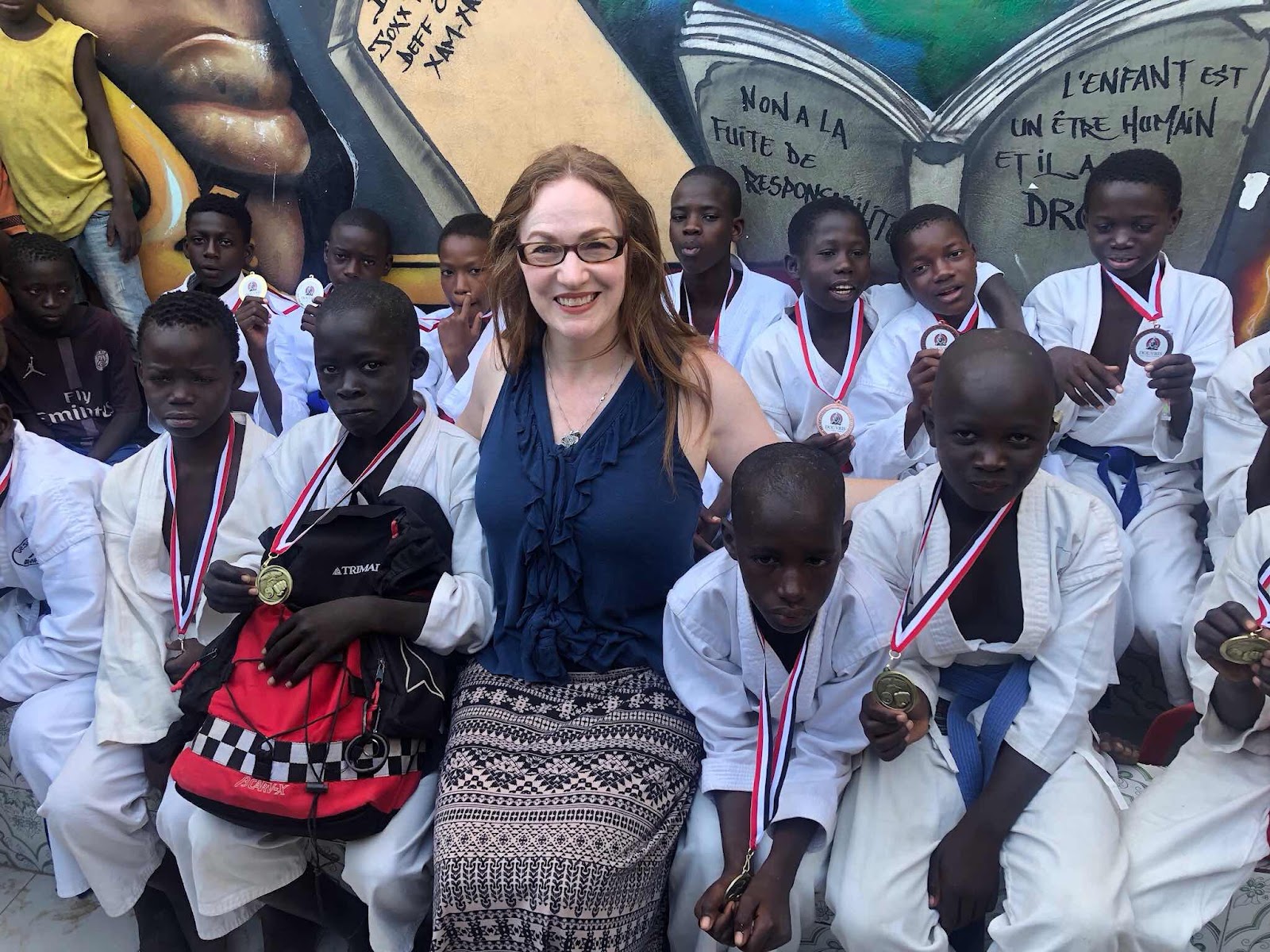
Robbie with last year’s winners

We informed Sensei Ignéty Ba of Sor Karate in advance of my arrival so he could prepare a list of karatekas who would be invited to compete, and inform them of the impending opportunity. There are two groups of Maison de la Gare karate students. About 30 young ones practice at the MDG centre Thursday and Friday mornings, and 34 older, more experienced ones who are sponsored by donors in Canada and www.Globalgiving.org to be members at the Sor dojo. When I arrived at the centre last week Sensei let me know that in preparing the competition list he realized eleven of the young students at the centre had been practicing karate diligently and passionately for at least a year, in some cases several. He felt that despite being too young to be permitted by their marabouts  (the person who controls them in the daaras they live in and forces them to beg for quotas of money) to join the dojo as members, they deserved WKF licenses and to test for yellow. Of course Robbie and I agreed!

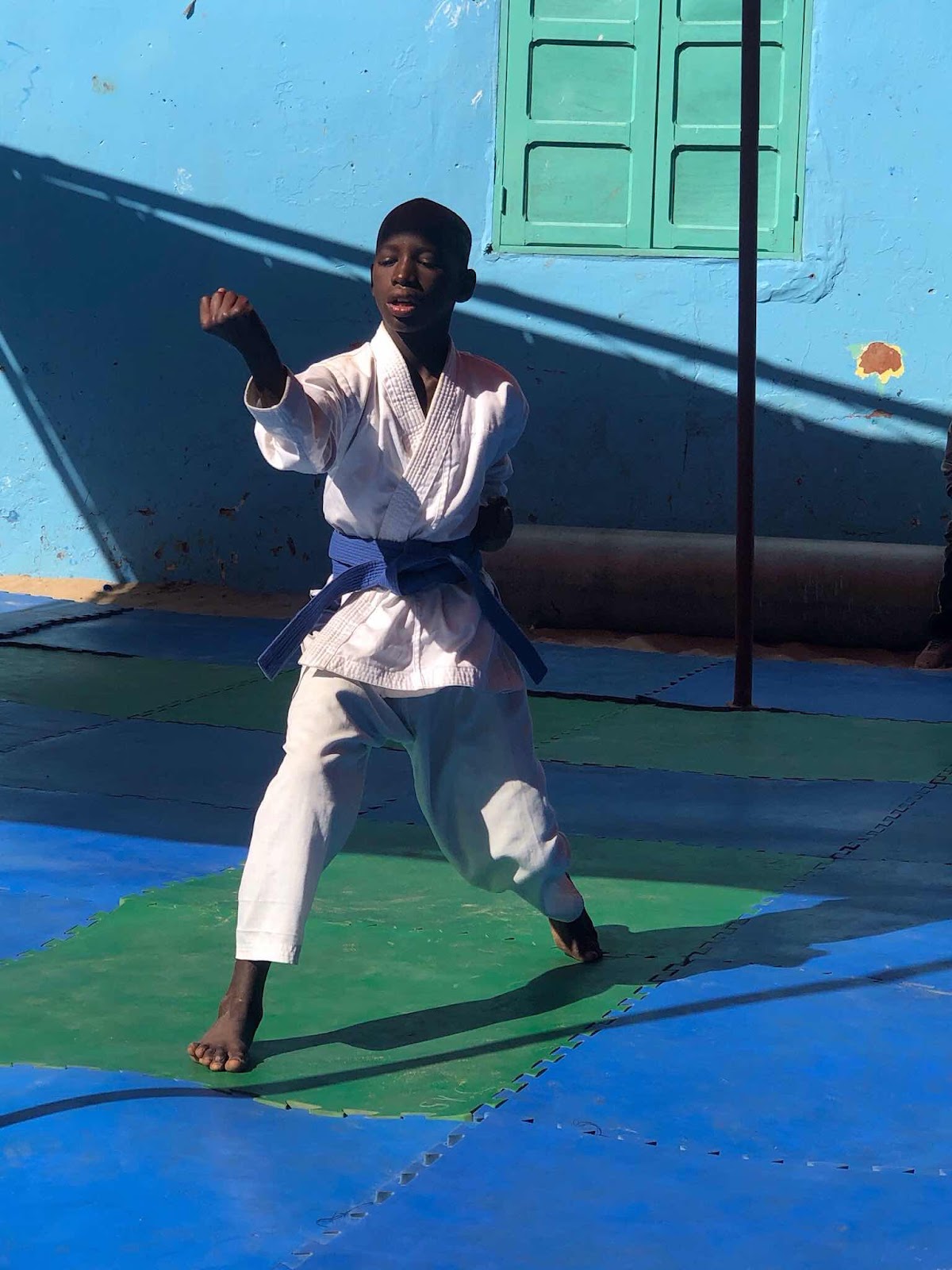
morning training

My first Thursday at the centre we announced to the young ones the eleven names of those who would be invited to test for yellow. Nine of them were present, and very excited about the prospect. The word would be spread to the other two. And all 29 were invited to participate in the tournament the following week. The next day I donned my gi and helped the kids prepare for the competition as well as for the rigorous grading test that awaited them. From past gradings Robbie and I have been invited to attend, I knew the pass rate to be about 60-70%. And we knew the main issue to be mixing up the Japanese names of different forms and stances and strikes and blocks. So I knew exactly what to help them practice. Interestingly, these kids has been passionate white belts for so long, they did not have the usual issues. The knew cold their Oisuki, Gyakusuki, adusuki, sotouki, garambarai, maegeri, their katas, and which was shodan, nidan, godan…and the kihon kumités looked good too. They all knew exactly when to Kia and how and when to salute. I had high hopes for grading day.


That night I also visited the dojo Sor Club to see the older MDG kids. They were also informed of the competition, and were very happy about the prospect for experience and the prizes. The Club Sor Demo team also planned a demonstration at the event. A visiting Karate Master from France was teaching a seminar that night, a great opportunity for the students. The President of the Regional WKF Association also attended the session, to greet the visiting Master. After. class, Sensei Ignety introduced all three of us, and thanked us for our long term engagement and love and support of the sport of karate. He also thanked Robbie indicating the MDG program and the hundreds of children it hasdeveloped in karate would not have been possible  without him. The Federation President similarly proceeded to thank us and discus the importance of karate to all martial artists and in particular to the talibés. I left the dojo that night feeling very humbled and honoured to be part of this amazing karate journey in Senegal. And…very proud of Robbie Hughes.


I arranged to meet the karateka hopefuls for the grading the following week at the center. We would distribute the donated gis I had brought from Canada, then walk to the dojo together for grading. The following day would be the tournament and the announcement of those who had successfully ascended to yellow. 


On grading day, some very worn out gis were exchanged, other very much too small ones were replaced. A final run-through of how to approach the ring, enter the ring, salute, and exit was reviewed for those who had only ever experience karate on the sand and never on a mat. Then we all set off together to walk from Maison de la Gare to the Sor Club dojo. We made our way through the streets, past vendors, down alleys, all at a brisk pace so as to arrive on time. I felt a bit like the pied piper for the 20 minute walk.


grading

After arriving at the dojo the kids donned their gis and lined up. Ten. Finally the eleventh, a yellow going for orange arrived. This was not his first time here, but for the others it was. Sensei would allow them to all remain in the dojo together, although they would be graded one at a time. This was a kindness, as usually all candidates wait outside and are invited in to grade one by one. For the candidates, nerves were understandably on edge. Expectations were high. Everything felt like it was on the line. The first name was called and I held my breath.


He began, and I let out my breath. He had this. And so did the next. And the next. I settled back and began to relax. But then, a very nervous boy turned the wrong way during taekyoku shodan. So hard to recover from that. He was thrown completely off. My heart broke as he was invited to step aside. There were no more mistakes from the remaining candidates. I was impressed! 


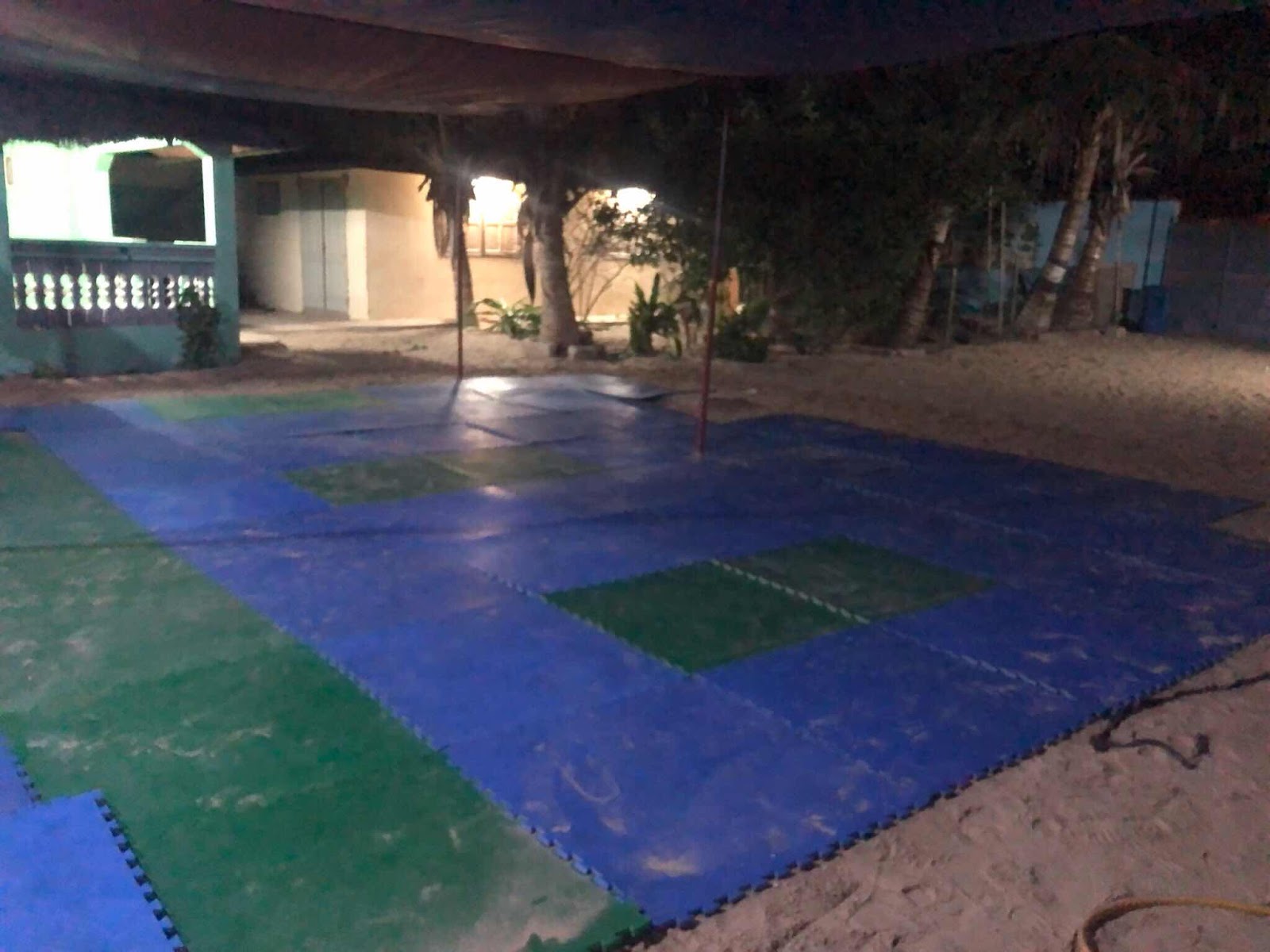
After grading the older karatekas arrived to help prepare the mats to be transported to the MDG center for the tournament. A horse-drawn cart arrived and the mats were loaded on. Night had descended, and the lights in the dojo had failed. But the cart was duly loaded up, and off it went to deliver the load.


The next day would be tournament day, souba. The successful grading candidates would be belted. And everyone would have their shot at glory! So much still to look forward to.

Sunday, November 24, 2019

A Time to Shine


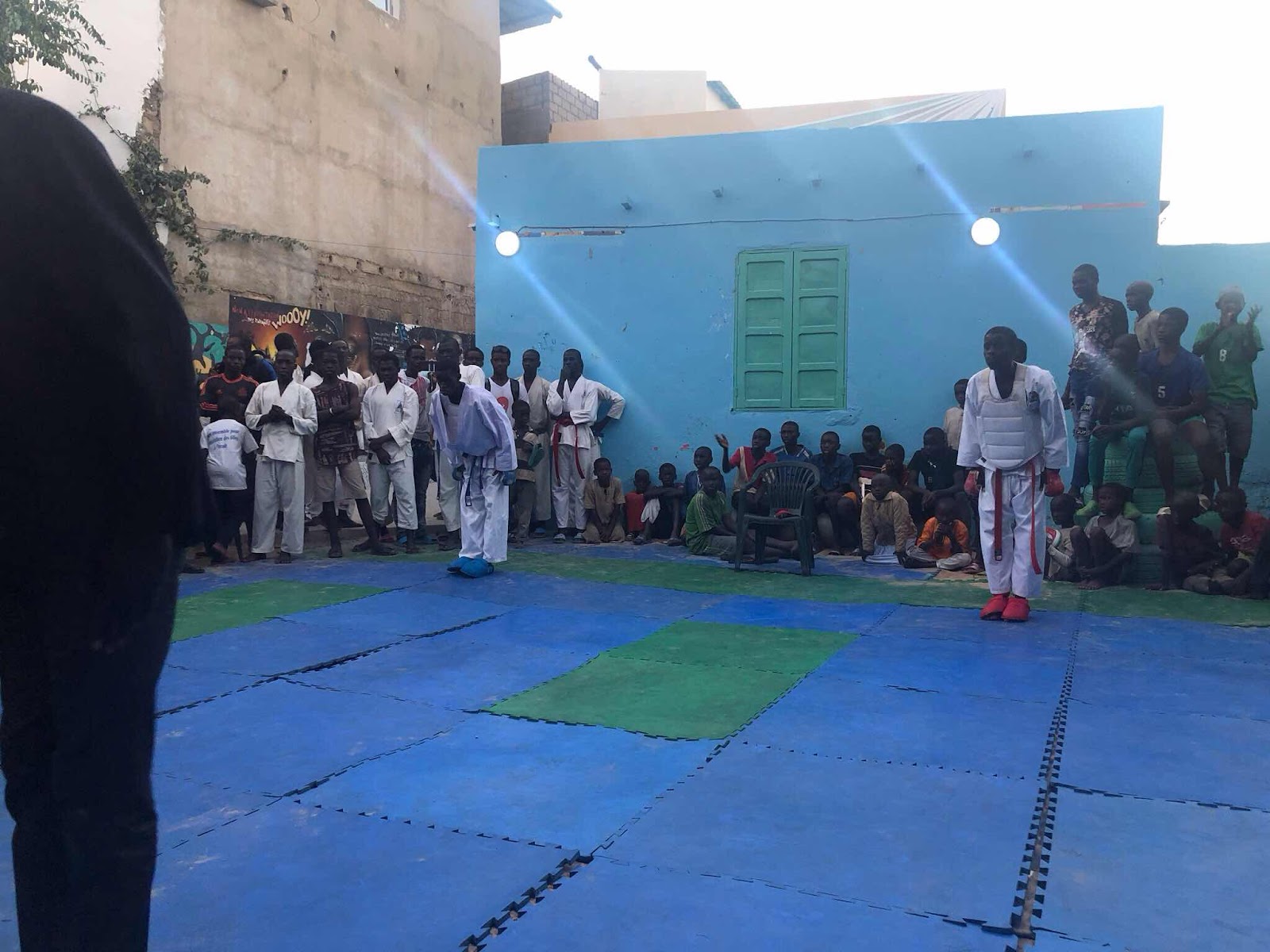
As the sun set before tournament day the Maison de la Gare-Sor karate kids set up the mats in preparation for the highly anticipated third Douvris Cup Classic. They had been delivered earlier that evening by horse drawn cart. Bouaro and I had compiled the lists of competitors earlier in the day, of the first four divisions planned for the morning. 20 young kids, white and yellow belts for kata and kihon. And, 11 older white belts also for kata and kihon. We were not sure who would be competing in the afternoon kata and kumite from among the more advanced dojo kids, and would need to wait to see who presented themselves to register. Bouro estimated perhaps 15.


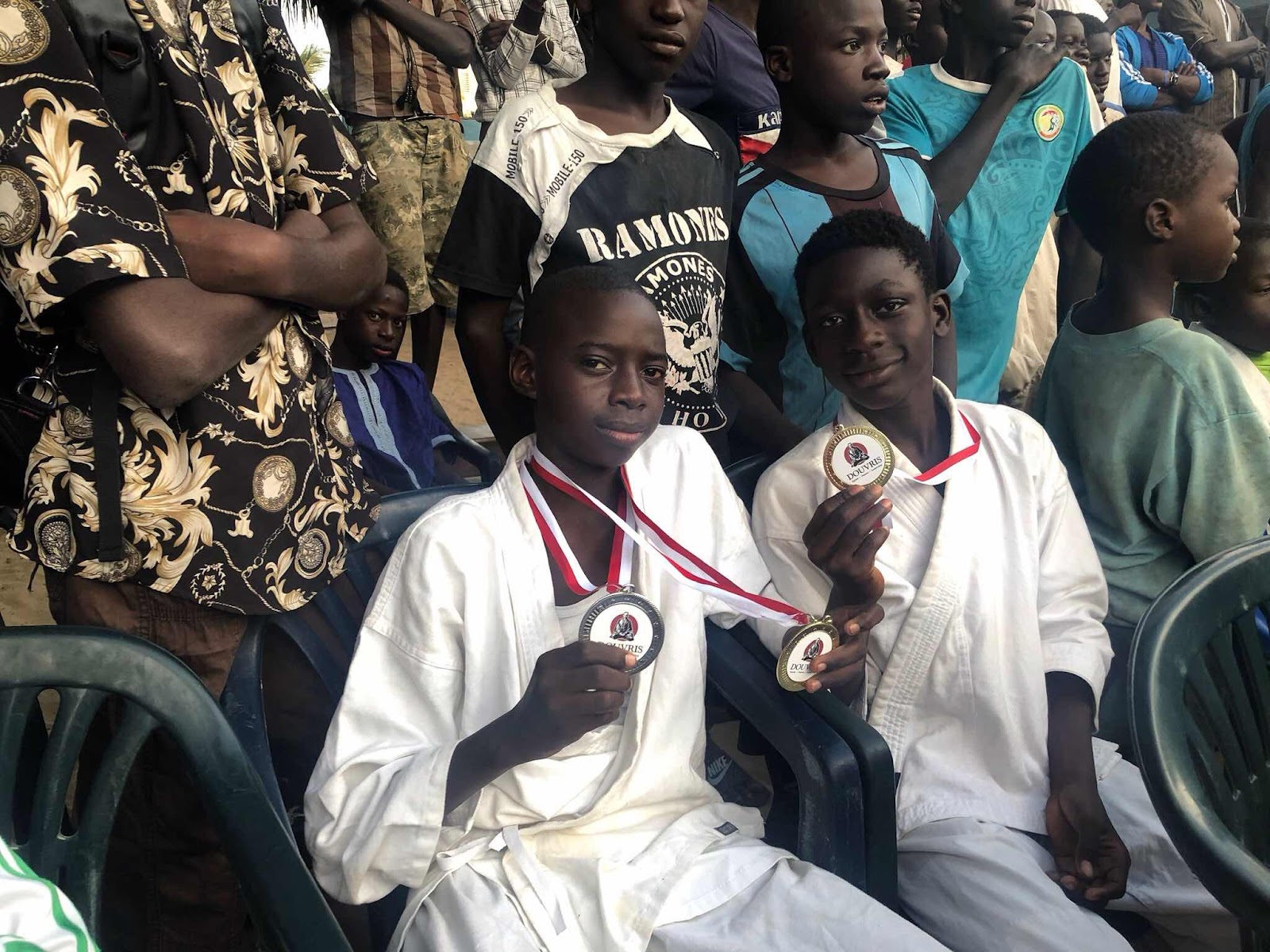
Douvris Martial Arts in Ottawa had donated enough medals for all the participants. And, I had brought with me the names engraved on plaques of the previous Douvris Cup winners to add to the trophies. Robbie's final two WKC Championship sweaters would be given as Grand Championship prizes, and Douvris t-shirts for the runners up. 


As the sun rose on tournament day I could almost feel the nervous excitement of all those talibé boys. About half of them had competed in previous Douvris Cup Classics. For the rest, it would their first time ever being in a positive spotlight, with an opportunity to shine and be rewarded for it. To show they are individuals with the ability to persevere and excel at an activity of their own choosing, based on their own hard work and determination. For the gold medalists and 2 grand champions, true glory awaited.

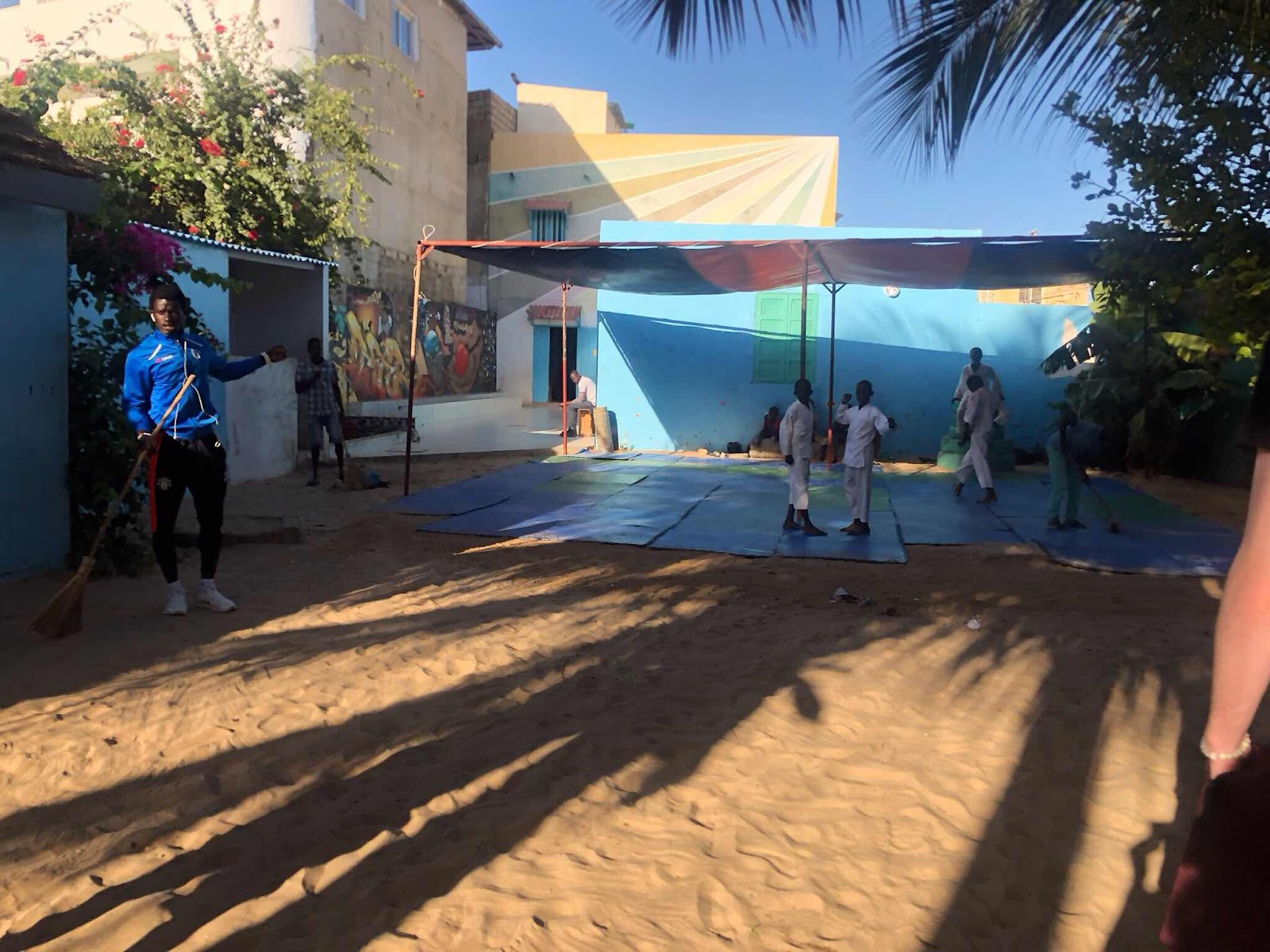
Robbie and I arrived at the center around 8:30am. The person with the keys to the room where the gis are kept and the classroom where the tables and benches were had not yet arrived. The kids set to compete in the first divisions were present and were busy sweeping sand off the mats and setting up a tent in anticipation of the full burning sun later in the day. 

Eventually the keys were found. As the boys donned their gis, Robbie and I set up the prize tables and laid out the medals and the Douvris Young Guns Cup. The Douvris Cup for the older dojo kids was in Dakar, where the previous two time winner, Ahmadou Diallo had proudly taken it to his family. I knew there would be a chance he had not yet returned it so we brought a temporary stand-in trophy donated from a Douvris student to replace it. Talibés helped set up benches for spectators, happy to be part of what was about to happen. The WKF sanctioned referees began to arrive, professionally sporting suits and ties. The chairs were delivered in the nick of time, a referee was positioned in each corner. Sensei Ignéty Bâ of Sor Karate presided at the head table, score sheets ready. The referees bowed in the competitors. The first pair of kihon competitors was ready to begin.


As each person stepped on the mat for his turn to compete, their expressions ranged from palpable excitement to anxious anticipation to deep, focused concentration to steely determination. The kihon instructions were called out in Japanese. All the boys correctly recognized the instructions. None mixed up soto-uki with uchi-uki or oisuki with jatsuki. Each time the flags were raised, either blue or red, the expressions changed: in each pair one deflated and the other became exuberant.

Eventually fourth, third, second and first were determined. Then, the process was repeated for kata. At the end of the first two divisions we awarded the placing and participation medals. But, the presentation of the Douvris Young Guns Cup would have to wait. The next two divisions of Young Guns, the older white belts who practice at the Center in the morning (and are not registered in the dojo at night) were not all present. Apparently some had been told they would not be competing until the afternoon or had responsibilities at their daaras they could not escape. So, we broke for a mid-day break and prayers (Friday is the day most visit the mosqué). 

Ahmadou Diallo arrived to watch the tournament (without the Douvris Cup). Upon presenting himself to Sensei Ignéty Bâ, Sensei insisted he compete. Ahmadou had not prepared diligently to his own high standard and had already decided not to attempt to defend his title. But, out of respect for his Sensei, Ahmadou put on his gi and prepared himself to compete for the third time. Robbie took Ahmadou aside to help him warm up and advise him on his kata choice and execution. After a few run throughs and adjustments, Ahmadou's confidence and determination seemed to have been restored and he was ready.

At 4 pm we reconvened. The second two divisions of Young Guns were dressed and ready to go. 9 of the anticipated competitors competed. Maybe the nerve of the other two had failed. Maybe their marabouts had detained them, it was impossible to know. 

I was astonished at the skill and focus of these white belts. This competition clearly meant so much to them. During the competition for third and fourth place one of the missing karateka presented himself, out of breath. His marabout had given him many jobs to do and he had not been able to get away until completing his extra assigned labour. Unfortunately, at this late hour there was no way to fit him in. He would have to continue dreaming of his next opportunity for now.


The same candidate won gold for kihon and kata. He would be the Grand Champion of the Young Guns, supplanting the morning winner of one gold and one silver. But, none of them realized this yet. First, the two divisions of dojo kids would have to compete.


There were 17 dojo talibés competing. The katas were beautiful to watch, each one a triumph to me. After the finalists were determined we moved onto kumité. By this time the crowd of spectators had grown to several hundred. The cheers that accompanied every hit were sometimes deafening. For both the kata and kumité finals it came down to Yaya and and Ahmadou. Yaya, whose membership has been sponsored by Douvris Barrhaven since nearly the beginning, has devoted himself to karate and he had markedly improved since the last Douvris Cup Classic. Yaya won gold in kumité and Ahmadou won gold in kata. Once again, the competitors would have to await the presentation of The Douvris Cup to know who the Grand Champion would be.

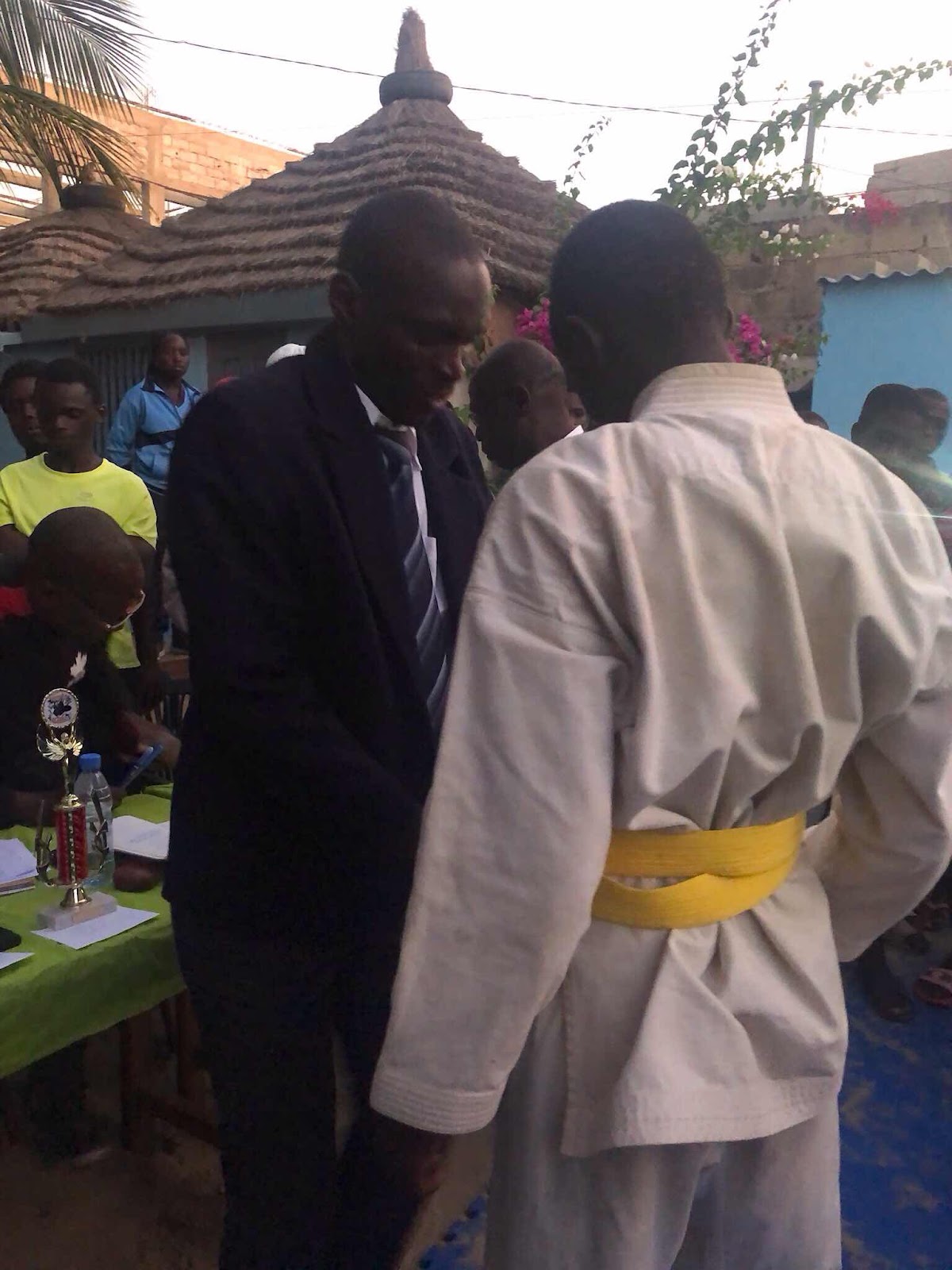
But first, the presentation of certificates and belts to the successful candidates of the last grading. several yellow belts were awarded, Ahmadou received his blue belt!


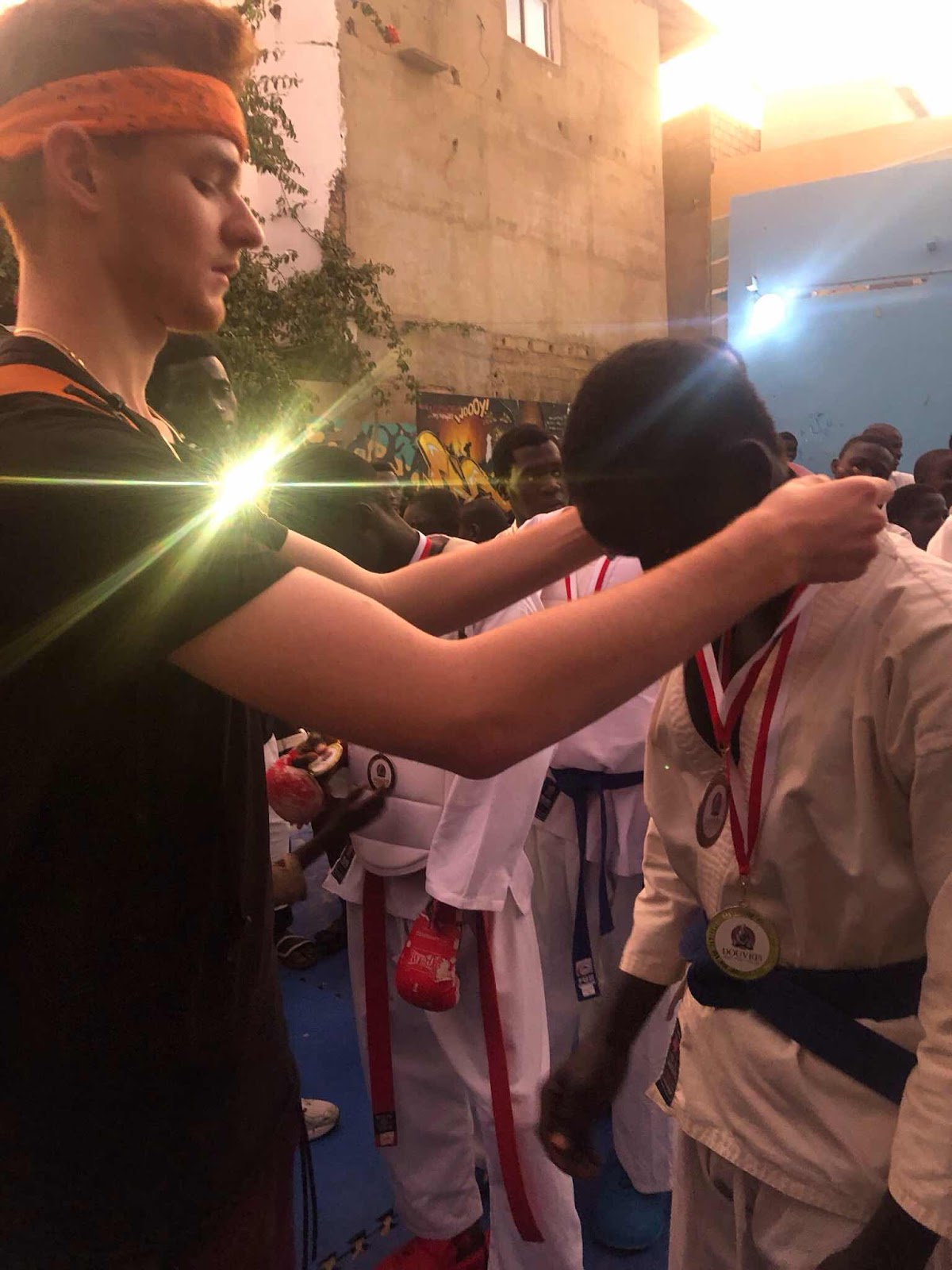
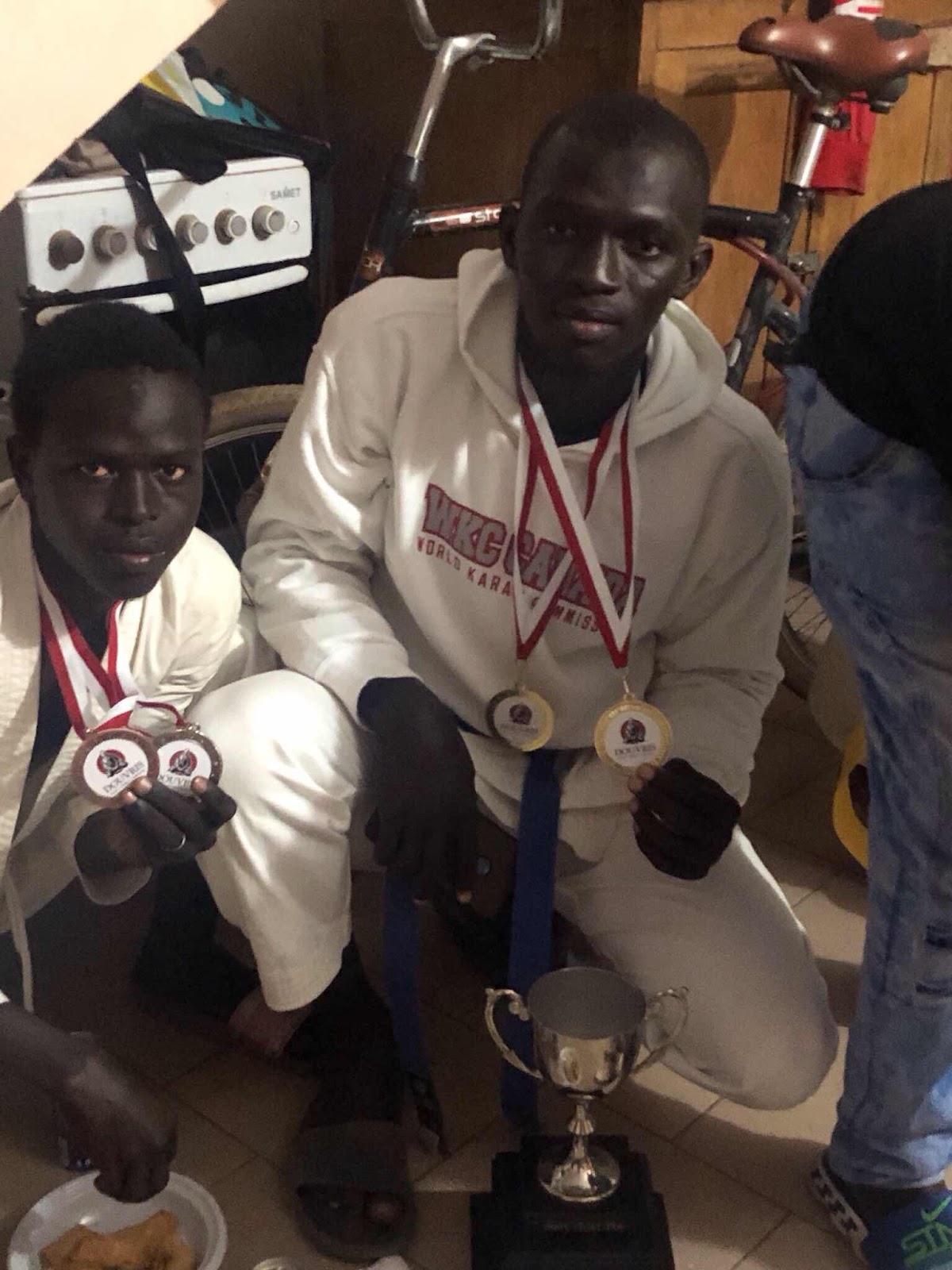
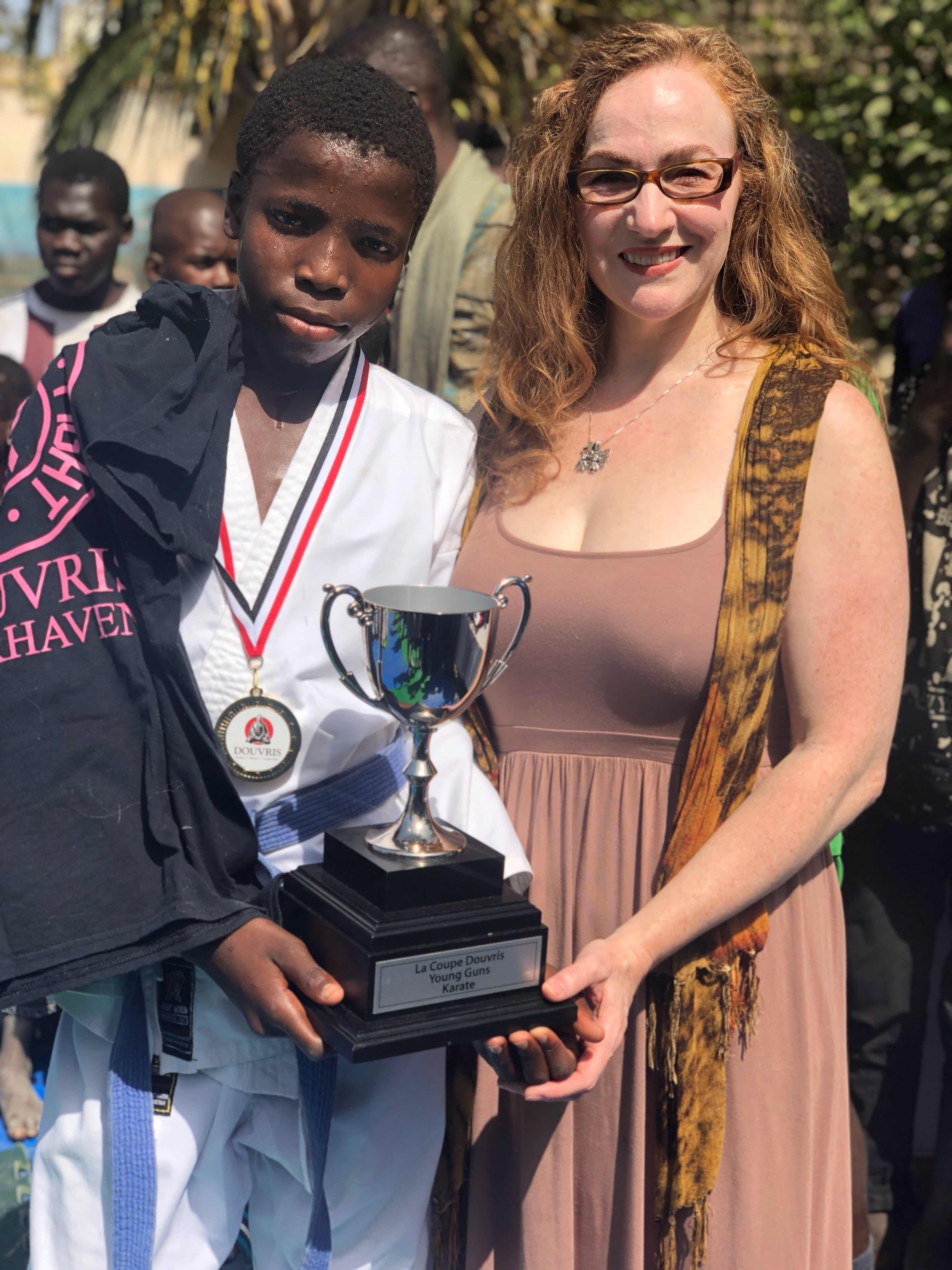
By now dusk had fallen. The head of the Regional WKF Karate Federation assisted in awarding the medals. He respectfully asked Robbie to present the gold medals. Finally, it was time for the Douvris Cup and Douvris Young Guns Cup presentation. Adama Drammeh was the new Young Gun Champion. When we return next time, his name will be engraved on the cup beside the previous winners, Seydou Ba and Omar Sow. This clearly was the first tine Adama had experienced a triumph such as this or won a prize. Despite the 32C temperature, he would not remove his new WKC sweater. And, I expect he is still wearing his two gold medals. Ahmadou Diallo was exhilarated to receive the Douvris Cup title once more. I showed him the two name plates to put on the Cup for his previous wins and explained he had now earned a third, which I would bring next time I returned. He promised to bring the Douvris Cup back to reside at MDG well before the next Douvris Cup Classic. I told him he would be able to keep the other temporary trophy permanently in exchange.

A feast for the tournament competitors was presented. It seemed the rewards and the accolades would never end. Surely in the hearts of these boys, this day and these feelings will be permanently imprinted.


The courage, confidence and self assurance of these talibés has been uncovered and locked down thanks to karate. Even if due to circumstances they cannot control, any of them are unable to continue in the MDG-Sor karate program, they have learned what they can control. They will never lose the gifts karate has given them. Each of these boys has been forever changed for the better.


Sunday, March 17, 2019

A Time to Shine


Karate began for Maison de la Gare four years ago. The very first classes were offered to talibés who did not know the sport, or the language in which it was taught, or the thirteen year old Canadian boy teaching them. But, it looked fun, and it did not require shoes (which they did not have), and they got to wear clean white uniforms, so dozens of talibés decided to give it a try.


Today karate is respected and adored at Maison de la Gare. For some of the many dozens of talibé karateka karate has become a burning passion. For a few, they say karate has become to them life itself. The young Canadian who brought karate here has now been four times, and he is well known and his arrivals are highly anticipated. And, all the karateka now understand the language of karate, taking their instructions in the Japanese universally known in the karate world. 

The karate students knew a tournament  would be hosted for them at Maison de la Gare. This would be the third in two years, so they had an idea of what was in store. They were preparing at the centre during morning karate classes and also at the dojo during evening classes long before tournament day. A few days before the competition Sensei gave a motivational speech to the competitors, giving them advice on how to focus and comport themselves during the event, as well as to congratulate them on their perseverance, dedication and accomplishments to date.


The morning of the tournament, the kids began putting the mat together. But, unfortunately, as they began piecing the mat together from all four corners, it did not come together in the middle as expected (as could have been expected). As the WKF referees began to arrive, one directed the boys to take the mat apart and begin again from one side only. They were very appreciative of how neatly the mat pieces fit together after using this method. 

Before long the prizes, medals, and the Douvris Cup were displayed as motivation. The five referees were present and ready. Sensei was standing by, and the competitors were dressed, lined up and ready to go. Maison de la Gare was packed with talibés, staff and visitors anxious for the competition to begin.


The first division was kihon, for the younger group of students who train at the centre in the mornings. Over twenty competitors performed as requested. Or, what they thought was requested (the instructions were in Japanese after all). After each pair performed, a winner was chosen. Then the winners competed again. And again, until only the gold, silver bronze and runner up remained. The process was repeated for kata. Then medals were awarded, and prizes for the winners. Candy sticks were given to all the competitors. But it seemed that all of them felt like winners.


At 1:00pm the tournament was suspended so the invitees and referees could break for lunch and to pray. Some of the competitors returned to their daaras, some went out to the streets to beg, and some remained to hang out at Maison de la Gare. The tournament was scheduled to resume at 4:00pm.  

At 4:30pm the group began to assemble again. By 4:45 the dojo talibés, and the older kids who train in the mornings were dressed, lined up, and ready to compete. A surprise: The President of the WKF Senegalese Karate Federation was attending, a great honour! He was seated at the head table beside Sensei Ignety Ba The referees turned to salut him. Then they bowed to the karateka. The boys nervously bowed back to them. The afternoon battle for the Douvris Cup was ready to begin.


First Kihon, for the morning older kids. This was the first time competing, ever, for these boys, all white belts. They seemed surprised and delighted by the audience's applause.


Then, kata, for the dojo kids. Some white belts, some who has passed for yellow, but not yet been granted their belts (that would happen later during the competition), several orange belts, and a few greens. For the tournament however, they were all equal, wearing blue or red. One competitor, in particular, orange belt, Ahmadou Diallo, performed a particularly spectacular kata. The crowd burst into loud, sustained shouting and applause, astonished at his skill, much to Ahmadou's obvious joy.


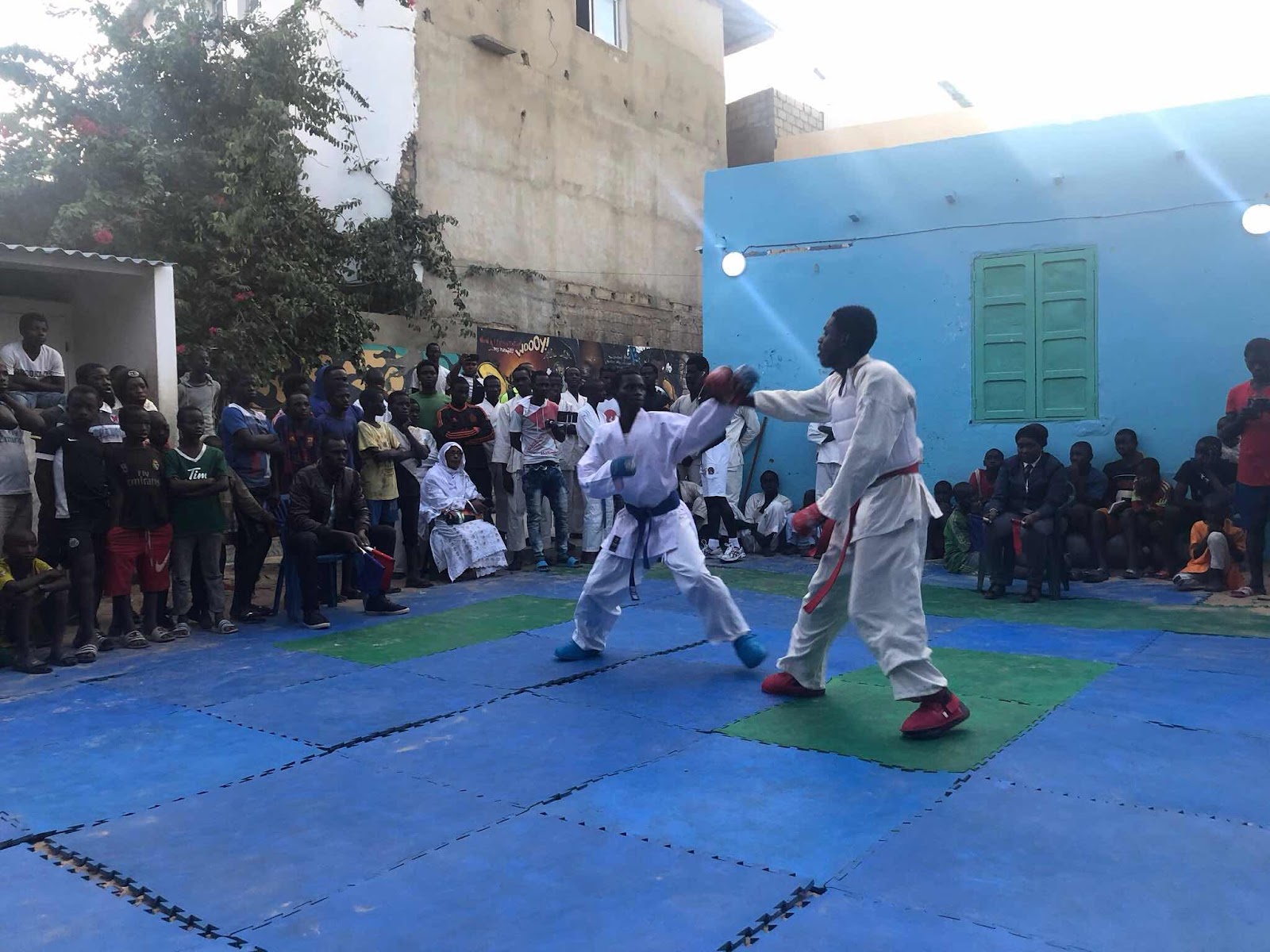
Finally, kumite, As the boys were paired off and donned their protective gear, the anticipation in the air was palpable. What is it about competitive fighting that excites people this way? The referee started the first pair. As they began to spar, the crowd grew louder. At first laughing as punches missed or were blocked, then clapping and cheering as hits were made and points called. As the fights progressed, with the winners moving on to fight the winners, the skill displayed increased. The noise from the crowd grew ever louder with each successive pair. Finally, the fight for gold. Veteran competitor Souleymane won the match, his roundhouse kick to the head his special weapon. But, one more fight remained, Ahmadou was fighting for third place. Although he did not realize it, he was fighting for the Grand Championship. If he placed third, he would win the Douvris Cup, having won Gold in kata. As the clock ticked down, Ahmadou received a blow to the face that required a call for the medic. After the all clear, he insisted on continuing. One more point was scored: Ahmadou!

The medals were awarded. Then, it was time for the Douvris Cup winner to be revealed. All the competitors who placed made sure their medals were visible to the judges, thinking to influence the decision. Then,,,"Et le Grand Champion de la Coupe Douvris est Ahmadou Diallo!" The crown went wild for him, he lept up, beaming with happiness and pride as he accepted his prizes and congratulations. 


Then, a ceremony to award the yellow belts earned the previous week. The President of the Federation awarded the first yellow belt, a wonderful honour, and an important recognition and vote of confidence in the Maison de la Gare talibé karate initiative. The founder of the program, Robbie Hughes, tied the belts on each successful grader, in turn. Many of the karateka thanked him, bowed, hugged him, and wanted their pictures taken with the young Canadian, crediting him with their opportunity to practice karate, make it their own. If only these boys could truly know how their strength, passion, and perseverance in the face of unimaginable obstacles, in turn, inspires Robbie.


This glorious day for the talibés, competitors and guests alike, will not be forgotten. As for the medalists, heroes forever!
u


Thursday, March 14, 2019

The Sounds of Senegal


It is the middle of the night. Silence. When the sheep bellows, it surely is heard for kilometers around. Still dark, the first call to pray sings out over the city, echoed  infinite times in every direction. Then, with the first crack of dawn song birds begin their morning ritual. Àt first just a few voices, rising gradually to a sustained cacophony. Finaly, the mourning  doves join the choir, and we know it is time to rise.

On the way to the centre, calls of "Sonia" distract me, slowing my progress to my destination. The words "madame", accompanied by the outstretched hand of a shoeless, filthy, tiny waif remind me why I am here, and after a pause to touch his hand and meet his eyes, I hasten my step.

As I walk up the alley toward the Centre, the bustling sounds of the street recede and laughter and childish voices reach my ears, growing louder as I approach the gate. Out in the city talibés are rarely heard laughing, they have work to do, collecting money for their marabouts, or to feed themselves. It is not a happy chore. But here, at Maison de la Gare, laughter feels more natural, children can be children. If only for a brief respite.


During karate class laughter is not the dominant sound. Instead, Japanese instructions are called and answered. A different kind of work, but this time it is a labour of love. A gift to themselves. Yoi. Ich. Ni. Sun.


At midday, the call to prayer rings out across the city again. The voices of the imams in each mosque separate, but linked, calling out to the faithful. As the call is answered, the bustle of the city diminishes perceptibly, one by one and in small groups, some slip into mosques, others roll out mats if they have them, and yet others kneel down in a quiet corner or on the sidewalk, more or less out of the way of those who do not pause to pray.


As the afternoon advances, a soccer game breaks out at MDG. The laughter is now accompanied by happy shouts, calls for the ball, and triumphant declarations. As the winners are announced, screams of joy, singing, chants of the name of the talibé who scored the winning point. The celebretory noises take a very long time to die down. Such joy only occurs here, at moments such as this. Why not draw it out. These sounds will ring in their hearts for hours to come. Until the versement must be delivered and all joy dies.

As the teachers arrive at the Centre, sounds of play are replaced by classroom words of learning. Scratches of chalk on chalkboards and tablets. Scraping of bench legs on floors. Quiet shuffling as a child shifts over to make room for a latecomer. All are welcome to join at any time. Each new entry is never a disruption. It is a triumph.


Another call to prayer. Another reminder, along with the hopeful faces of the children in class,  that God is here. 

Maison de la Gare's gate clangs shut for the night. The sound is more quiet, somehow sadder, as feet are walking away, back toward the road and a very different reality.


Monday, December 3, 2018

The Douvris Cup Classic - The Young Guns in Canada Deliver Karate to Talibés in Africa


It has been just under four years since the karate program at Maison de la Gare began. Founded and nurtured by my son, Robbie Hughes, Maison de Gare karate has been enjoyed by hundreds of forced begging talibés. Karate classes on Thursday and Friday mornings at the Maison de la Gare centre, led by Boiro, of Sor Karate are frequented by about 20 kids daily. And, There are now 32 talibés registered in the evening dojo classes as members of Sor Karate.


Each year Robbie calls the families of his own dojo, Douvris Martial Arts in Ottawa, to action; raising sponsorships for the Maison de la Gare dojo karate kids; their annual fees must be renewed each January. Two young Douvris Karateka siblings were inspired by Robbie to contribute toward helping talibés enjoy the sport they also love. Robbie always donates part of the money he earns. Kayli and Keagan have saved their allowance for the past two years, enabling two boys to join the dojo. This year, six year old Kayli decided to step up her commitment to Maison de la Gare. For her birthday last month, Kayli asked her friends to give to Maison de la Gare instead of gifts for herself. She raised $105. One sponsorship for a year is $100, covering the annual registration fee and WKF license, monthly fees, and regular belt testings. 


For this trip to Senegal I had planned a karate tournament for the talibés to compete, showcase their skills, and taste glory for the first time in their lives. Robbie and I invited Kayli and Keagan to sponsor it with the money raised from Kayli's birthday. Upon thoughtful consideration, the siblings decided, instead, to do something bigger, and use the opportunity of the tournament and Kayli's fundraiser to challenge their teamates to give as they do; to share their good fortune in being  able to practice karate, train and compete at what they love to do. So, the week before my trip to Senegal, Robbie and Kayli and Keagan stood in front of their teammates and called out the Young Guns Douvris Challenge.  The Young Guns are the junior members of the Douvris Karate competition team. Robbie spoke about the talibés, the lives they live, and how karate is so meaningful to them. Kaylie talked about how she used the occasion of her birthday to generate contributions for Maison de la Gare and of how important it is to help other people. And, Keagan spoke about how he was able to set aside his allowance on a regular basis in order to be able to make a significant impact on another child who needed his help. Inspiration was definitely in the air at Douvris that night. In fact, inspired by Kayli's example, another young Team Douvris member, Anna asked for birthday donations to Maison de la Gare as well. I was already in Africa when I received the wonderful news that she had raised $251 for the cause. One


 dollar of this had been offered by Huxley,  a team member who answered Keagan's call and decided to donate his allowance on that day. It is quite amazing how much inspiration a single dollar can pack! As I told the talibés Keagan and Huxley's stories and how Kayli and Anna preferred to give their gifts to the talibés instead of themselves, the boys were astonished. As I showed the picture of Robbie and Keagan and Kayli and a picture of Anna at her birthday party holding up a donation instead of presents, to one boy, indicating they helped to make the tournament and karate possible, he examined it, then pointed to himself in surprise, understanding dawning. Then nodding his head, he smiled. Dierudieuf. Thank you.

At the end of our first day on this trip to Senegal, I went to visit the dojo to see my karate boys. They knew about the upcoming tournament and had been training each day for extra hours, practicing their competition katas, kihons and Kumite. A few of them had competed before, sponsored by Maison de la Gare to a regional competition, and on one earlier tournament that Robbie and I ran at Maison de la Gare. But, 90%  of the competitors had never experienced a tournamnet before and did not know what to expect. Many had seen photos of The Grand Champion Cups on line, from when I posted pictures of Kayli, Keagan and Robbie's Young Guns Challenge presentation: La Coupe Douvris Karate and La Coupe Douvris Young Guns Karate. The desire to win was palpable in the air at the Sor-Karate dojo. One boy, Yaya, who had recently earned his orange belt had hurt his ankle but there was no way he was going to miss the oportunity to compete. Seeing that he would not be persuaded to follow the wise course and rest his ankle, I gave him antinflamatories and painkillers, so he could at least mnimize the damage and get through the competition. I know how this works, Robbie has competed with a not fully healed broken wrist, not willing to let an important qualifying tournament pass him by. To these kids, karate is life. They will not be denied their opportunity for glory for some short term pain.


Wednesday I joined the karateka at Sor-Karate dojo to train. It felt good to stretch and work my muscles after such a long time sitting in cars and airplanes. It is always a bit of a challenge training in the dojo here, in a good way. My Japanese is improving, so I am using the correct strikes and blocks more often now. Most of our katas in Canada are the same, with slight variations to pay close attention for. But, interestingly, most have almost exactly the same timing as my senseis instruct at home. 

The next day 15 new karateka from the morning program at Maison de la Gare were being registered at the dojo, bringing the number of active members back up to 32.  They were waiting for my arrival for authorization to join the dojo and receive some needed Gi's. They know I always bring more, compliments of our Douvris family. With confidence that Robbie, Kayli, Keagan and the Douvris Young Guns would be able to inspire 32 karate sponsorship renewals by Christmas, I signed them up! Over the year some of the karateka drop out of the program, usually to go back to their home countries or regions as they finally age out of the talibe forced begging system. Sometimes they are sent to other regions as forced labour to work their marabout's fields or build him a new house. Even those that will no lonnger practice karate will not leave behind what was learned in the course of becoming a yellow, orange or green belt. They will always carry with them the confidence, self respect, discipline, and dignity that karate gave them. And, they will remain part of the martial arts community. There is a comradeship among karateka here. On our final car ride back to Dakar I heard our driver answer "os" instead of "yes" while speaking on his cell phone. Only a martial artist would do that. It turns out he is a brown belt, having practiced karate on and off for 18 years, but no longer active.  Karate is still part of him, however, and we connected instantly, bonded by something each of us deeply understand. The Maison de la Gare karateka who have moved on will always have this also.


Thursday morning was Karate at the centre in the morning, led by Boiro. Boiro arrives usually by 7:00am, long before anyone else, to sweep the sand clear of stones, shells, and any sharp objects that could hurt his karateka's feet. And, he prepares the Gi's, organizing them for the class to come. At 9:00am the class begins. The most serious students arrive early, anxious to profit from every moment of instruction possible. they would already have been begging for several hours by now, and the break for karate is very welcome. Another group arrives later, around 10:00am, don their uniforms, and joins the class. It is about 35 degrees C by now, the sun beaming down on the class. The heat never stops anyone here, however.


Thursday night, to the dojo again. There is an early evening class at the dojo Thursdays for the younger karateka from the morning classes. They get a taste of dojo training, and it inspires them to persevere, and imagine that some day they will be able to join as full members also. The juniors would be participating in the tournamnet the next day. They would be competing in two divisions, kata and kihon. The overall Grand champion would earn la Coupe de Douvris Young Guns Karate. Sensei demonstrated what to expect on entering the ring. Where to wait. How to bow. How to know when to begin, and how to back out again. Each boy had the opportunity for a test run or two, including running through his kata in full dress rehersal. Excitement was in the air. As evening fell, A horse drawn taxi arived to collect the mats and deliver them to Maison de la Gare. Souleymane climbed up to escort the load to its destination. Later, the older boys arrived, and practiced later into the night, their last chance to perfect a kata or drill before the big day.

Friday morning dawned; tournament day. The Douvris Cup Classic was about to begin. I arrived at the centre carrying the prizes. The mats were layed out. Tables were ready, waiting for the prizes to be displayed. The junior karateka, the Maison de la Gare Young Guns, were gathering and donning their Gi's. The WKF sanctionned referees were brushing off their suit jackets and straightenning ties.  As I layed out the Douvris gold, silver, bronze and participation medals, the karateka gathered to see. And shirts for the Gold medalists. Then, La Coupe Douvris  Karate and la Coupe Douvris Young Guns Karate were revealed. Many boys came over to indicate the Cup would soon be theirs. There was more than a little good natured trash-talking.

Then, as the referees called the tournament to life, it was on. I could feel the nervous anticipation in the air. Confidence, mixed with terror, mixed with joy on the face of each competitor, in turn. After each pair, the red or blue flags were raised. Followed by devastation, or exultation.  Kihon was first, the requirements called out in Japanese.  Next was kata. Each pair presented themselves at the ring, bowed to each other, to the judges, then advanced in turn. After each performed his kata, the blue or red flags indicated the winner. Some of the competitors nerves got the best of them, forgetting the kata partway through, adding extra moves by accident that threw them off their groove. But, none gave up. The demonstration of courage and perseverance at this tournament was extrraordinary. Even when one boy in a pair was clearly exceptional, and his oponent had made mistakes and forgotten his kata, both seemed to believe they had a chance of winning. Hope is alive and well in the hearts of these boys. There was extra formality for the final matches. So much was on the line. The boys who had made it this far knew that ultimate success was within their grasp. As the blue flags were raised in Seydou Ba's direction and he won the gold for kata, my heart soared along with his. I also felt the temporary disappointment of Oumar Sow and his transition to joy with his realization that he is the silver medalist.


Finally, it was time to award the Douvris Young Guns Cup. As Seydou's name was called, the expression on his face said everything. The crowd ahhhed in appreciation, then cheered as Seydou stepped forward to receive the Cup. 

After a mid-day break for lunch (back to begging for the talibes) and mosque, the second stage of the Douvris Cup Classic was ready to go. I laid out the senior prizes: white muscle shirts for each competitor, and black for the gold medalists, as well as gold, silver, bronze, and participation Douvris medals, and of course, the Grand Champion Douvris Cup. For the seniors, there was also a special prize for the gold medalists and grand champion of some money. Not much to us, perhaps. But to a senior talibé, the prize could represent a week's holiday from begging or lugging goods in the market. And, the Grand Champion would be twice rewarded. The senior competitors seemed just as nervous, yet determined as the juniors had been. Kata first. Some of the karateka who had devoted every spare minute of the past few weeks to training were spectacular. Their dedication paying off. The talibés watching from the sidelines looked on in awe. There was a buzz in the air about karate - likely many more will present themselves next Thursday morning to Boiro, asking for a Gi so they can join the classes too. When Amadou Diallo won the gold medal kata match, his joy was irrepressible. This day, he was no one's slave. He was a winner - a Champion! And, everyone treated him accordingly. 


Kumite was as stressful for me to watch as it is whenever my son, Robbie competes. These boys trained well, and they are strong. No punches were being pulled. No helmets here. But, whenever one boy faced another who was bigger, the referres made them put on chest protection, thank goodness. We have to get these boys mouth guards. The ones Robbie and I brought a year and a half ago are long gone.  Souleymane N'Diaye, a long time friend of Robbie's, and Mamadou Ba fought for gold. Mamadou Ba appeared to be on top of this one. Souleymane's particular fighting style and unique kias's had the crowd laughing at first. But, his hook kick to the head is his secret weapon, and as he started to hit the target, the crowd's laughter turned first to applause, then to adoring cries of  "Souleymane! Souleymane!". In the end, Mamadou Ba took the gold, and Souleymane the silver. Both earned a level of respect here that will not soon be forgotten. When the matches appeared to be over, it seemed there were two bronze medalists for each of Kata and Kumite. I felt bad insisting on a final match for kata, and kumite, to compete for the bronze. And, it was getting dark. But, there was only one bronze medal for each division. For Amadou Diallo, much was on the line for his fight - He could win the Douvris Cup if he could win his Kumite match and win the Bronze, already having won the Gold in Kata. Otherwise, the Cup would likely go to Mamadou Ba, the Kumite gold medalist who had not placed in kata. Amadou fought as though his life depended on it. The kunite match went to overtime. Everyone was on their feet, each strike and block was accompanied by cheering. I was too caught up in the action to remember to take photos. With Amadou's final, winning point, the crowd went wild, and so did Amadou!


There is no doubt in my mind that this was the best day of Amadou's life. As he held the Douvris Cup high, Amadou's joy was not to be contained. He could hardly believe that he was the Grand Champion of the Douvris Cup Classic. All those hours of dedicated training had done it, against more experienced and bigger karateka, proving to all that anything, truly, is possible.

After the medals and prizes were all awarded there was one final, very special task for Sensei Ignety Ba. Boiro had been a brown belt ever since I have known him, nearly four years. Achieving black belt here is a challenge, as it is anywhere. But, the fees and competitions that are black belt requirements can add up. And, for a talibé, where is that money to come from? Now that Boiro is part of the  Maison de la Gare program, His fees are covered. Last month he completed his requirements for black belt. But, the last stage of waiting for the black belt to arrive from the authorities can take months.  So, this night Boiro proudly accepted his black belt, sent from Douvris Martial Arts in Canada, a faster result than the Senegalese route. Boiro, now a sensei teaching karate at Maison de la Gare, let me know how proud and happy he is, crediting Douvris with  the succesful turn his life has taken. I try to explain that it is he, himself, who earned this success. One thing is undeniable, that this was the best day of his life so far. There was a lot of this feeling going around on this glorious day.


Amadou could not bear to part with his trophy just yet, which will be used again at future Douvris Cup Classics in Senegal. His name will be inscribed on the side - the first of many.  So this night he took it back to his daara, proof of his glorious accomplishment, to himself and to others. Seydou's Young Guns Cup is still at Maison de la Gare, being passed around for everyone to admire and respect, before Seydou's name is engraved on it for all time. This experience is surely engraved, as well, in the hearts of the Champions and all of the competitors, not to be forgotten, ever.